Corvette Consternation Part 1 Steering

Every one that reads this blog knows that older cars, no matter how careful you, or how much you baby your car you are going to have problems.  That’s the nature of any relationship.  Things break, undiscovered issues, or even your own missteps can issues.  You just can’t through in the towel “Honey, I’m going to have to find another mate, you just can’t run as far as you use too.” or “Sorry but that broken leg changes everthing…ur outta hereeee.”  (Lawyer up…my wife is fine, no injuries, still running fine..no worries…just wanted to be clear!!!!)

Well, over the past few weeks my Corvette has been a serving up a bunch of consternation.

If you remember a few posts back I had replaced one power steering hose and need help with the power steering reservoir.  That got done.  Shortly after that, a leak developed from the front end and over the course of two days it got a little worse.  So I pulled it in to the garage and crawled under neight..and that’s no small effort. 

The power steer of course provided hydraulic power to make the turning of the front wheels easier. (There you got the basics of the how it works.)  This entire process insists that the fluid, in this case power steering fluid stays in place.  Well my beauty failed conform to the standards. 

Rack Pinion

If you look at the image above you’ll see the plastic boots (A) that cover and protect the shaft.  Those are supposed to be dry.  When I touched the boot on the left side of the Vette fluid poured out, clearly it was no longer dry.   What was also very very clear at that exact moment was the pain in my wallet. 

Basically, the you have two options when something that is supposed to be dry is wet on a car, replace it or rebuild it.  I chose both.  Lucky for me the complete unit for my 84 Vette is still available through on-line Corvette parts houses.  EEERRRRKKKK..While I’m writing this I have the Speed channel up on up in the corner of my monitor, they are testing an Aston Martin DBS against a  Bentley w/ W12 engine…soft girl cars…of course that girl’s got some skills, putting eyeliner on at 150 miles per hour!!….end of EERRRKKK – I’ll let you know how that turns out.

A quick trip down the street to Tim Sisk proved my investigative results.   I’m the Average guy with Average skills, there was not something I wanted to attempt. Additionally, it requires a front end alignment.  So I order one, and because I hate having the car in the shop I had it expressed shipped, or at least that’s what I asked.  It didn’t shipped and took a total of four days.  What…you say…”oooohhh poor baby, took 4 days to get it here!”    Hey, that’s a life time for some car guys!!!!

Now ordering the rack and pinion requires a core charge (that’s where you have to return the old part or pay the core fee – they rebuild the old part and resell it) but as I stated I wanted to do both so I paid the core fee and kept the part.  This allows me to either learn to rebuild the part or sent it out to have it rebuild and store it way.  Plus I have the original part, although there isn’t much benefit in collector value for having the orignal rack and pinion (numbers matching) 84 Vette, well least not for another 20 years!!!!

The part was replaced and the car realigned, in total it was out of service for a solid 7 days. Picked the car up and drove it home and that was that…and if you believe that, I have some swamp land out here in AZ to sell ya!!!    Stay tune for what happened next

Oh…the Aston Martin and Bentley match up.  Here the details:

Braking 0-100 to 0 (time speeding getting up to 100 and then distance measured for stopping-shortest distance wind) ….15 second from 0 to 100 for both cars, breaking the Aston won at 40 feet shorter stopping distance.

60-130 test on roll – Bentley win 13.2 second, nearly a second faster than the Aston

The rolling mile  – top speed 165 mph for Bentley, 1 second faster than the Aston – 159 mph

Road course – 55.6 seconds for the Bentley      53.8 seconds for the Aston

Like I said – girls car..my 84 Vette has a top speed of nearly 200 miles an hour.  My personal best, 174 mile per hour in the Vette – yeah that’s just last year.  Dyno proven.

Thanks for reading.
Auto Factoids for 8/22/2010

Very like week this week. 

OH….the Corvetttes at Carlisle is a huge event going on over in Carlisle PA.  I might make it there one of these years. 

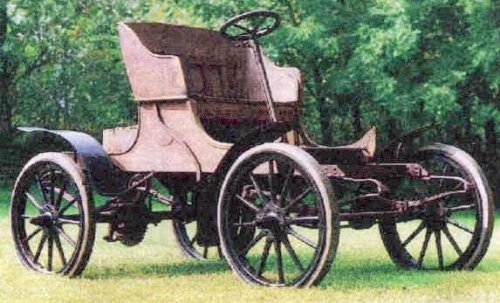
For all you caddy lovers on 8/27/1902 the Cadillac company was born.  Yup it was its own company. 

This sure isnt' what one thinks of when they think of a Cadillac


Oh and this was the olds from around that era: 

1897 Olds.


London, England had an auto (and plane) historical event this week.  Charles Rolls was born on 8/27/1877 (Rolls Royce). Beside creating the an iconic car, they did plane engines and more. 

1903 Rolls Royce


Thanks for reading. 

Tim

Auto Factoids for 8/8/2010

8/8/55 – test of first solar car.  William Cobb  created a prototype, but it was only a 15 inch model. Basically, an electric current was produced that in turn powered a tiny motor. The motor turned the vehicle’s driveshaft, which was connected to its rear axle by a pulley. I couldn’t find a pic of this one.  However, Alan Freeman developed the solar-powered car  in 1979 that you could actually put a human in.  Here’s the pic.  (It’s really just a bike…I think.)

Alan's Solar Car.


8/11/66  Chevy introduced the Camaro.  There is some discussion on whether there is such an animal as a 1966 Camaro, they  were, build in 1966 but sold in 1967.   Here a  pic.

8/15/56 Packard no longer producing cars in Detroit.  Previously the Packard company bought Studebaker and tried to keep the Packard name a live in 1957 by reworking a Studebaker and give it the Packard name.

1956Packard


1957 Packard...looks alot like Studebaker

8/21/1897  Oldsmobile becomes a company. Of course the company is no longer in business another icon gone.

1897 Olds

Thank’s for reading.

Tim

Wrenchin’ Tip Engine Swap 8/15/2010 Label It!

Now the Mustang is a fairly simple machine, even the electrical system is easy to work through. Pls note, I hate electrical problems and I equally dislike having to chance them down and I don’t care how simple it is.  My 84 Corvette is nothing short of a nightmare. 

Keeping this stuff straight is hard to do.  Now tearing out an engine doesn’t necessarily mean you are starting out with all new wiring, but it could.  A tip I use is to label everyone single wire with (normally) white duct tape. 

Like so: (not white duct tape!!) 

This actually reads: Starter Relay. (Yeah...spelling issues..like you haven't noticed!!!)


This is eXtremely handy.  For example there are no less than 18 different wires just on the driver’s door for the Corvette.  I’ve taken the door apart so many times for repair, that I started leaving them labeled. 

Of course you can use this for hoses, lines and parts. 

Thanks for reading. 

Tim

MOPAR’s 318 Part II

Before I start this next segment on the 318, I have to admit that organizing and presenting this work of art (oh..yeah..I’m laughing too!!!!) could have gone in a lot of directions.   The two that stuck out the most for me was by year (chronologically) or by brand.  Neither was a solid idea and at some point in the ’70s the only thing separating brands within most U.S. car manufacturers wasn’t much more than vinyl vs cloth seat covering.  So I decided to go with brands, Chrysler, Dodge and Plymouth, knowing that there we would be some crossover information and it might look a bit disjointed.  There’s some good stuff, and a couple of things you might know about the 318.

Chrysler began using the 318 in 1967 and carried that power plant until the late 1990s.

From 1967 to 1971 the 318 carried a 230 hp rating w/ the standard 2 barrel carb, managed 340 ft lb of torque and sported 9.2:1 compression ratio.  (that is actually a lower compression ratio than the original Ford 250 straight six I took out of my Mustang).  In 1967 the 318 engine was used in the Belvedere, Satellite, Fury, Coronet, Polara and Charger and in 1968 they added as the base option in the Dart GTS and Barracuda.

1967 Polara 4 door.


From 1972 to 1979 the 318 was bounced around in the horsepower arena between 150 to 140.  That’s nearly 100 hps lost from the late 1960’s.  At lower end of the new scale were the California models with the extra smog control.   It was still a mainstay, being the base engine choice for the Duster,  Cordoba, Monaco, New Port and unexpectedly the Road Runner,  just to name a few. It was never sported anything bigger than a 2 barrel carb and the compression dropped to 8.5.

It didn’t get any prettier in the 80s either, although there a bit of a bump in the high-end of the hp range to 175 hp but the company more than made up for that dropping the lowest number 120.  Interestingly, they made the California models with 155 hp and a 4 barrel carb.  The compression stayed about the same, but  in ’83 – ’90 they made a HD version of the engine that had between 165 to 175 hp, depending on the year and sported a 4 barrel carb.  This configuration managed to lay down 240 – 250 ft lb of torque, not too bad in one of the lighter cars, like the Dart, but barely power enough for the big old St. Regis. The 318 was also added to some of the most memorable cars….come on..you doesn’t remember “vooo..la rau….oh..oh…” (Volare )and the LeBaron, and Aspen.  Even some larger cars like the St. Regis, New Yorker, Gran Fury (I can’t see any car begin called grand with only 120 hp, but that’s just me.) and the Imperial.

1976 Volare


Oh and speaking of the Imperial something interesting happened in 1982 and 1983.  That little something was EFI.  More on that in the next segment.

Thanks for reading.

Tim

’89 318 efi intake to ’79 carbed 318 – Mopar Forums

Hello, my brother and I are thinking of taking on a project and would like to know if the throttle body injection components from the 1989 318 in his truck will work on a 1979 318 engine. The reasoning behind this is due to our …

Wrenchin’ Tip Engine Swap 8/8/2010

At some point I’ve promised myself I would cover the restoration stories that center around my 1970 Mustang.  There is a lot to tell, trust me!! I’ve learned a lot!!!  

Engine - Before (250)


Engine After - (302)


But for this Wrenchin’ Tip, I’d thought I’d share a few hints that I did pick up.  Just to be fair I didn’t  do a lot of the engine swap work myself (Average Guy w/ average tool and average skills) but I learned a lot of general helpful hints and some Mustang specific helpful hints!!!  

So here are a couple of tips:  

 1.  Planning and scheduling a restoration is important.  If you are doing an engine swap or pulling it out for an overhaul make this the first step in your restoration.  Yes, I’ve seen the TV shows where they put the engine after the car is back from the body shop.  But hey this is the real world, and in this world, money is tight and body work is expensive enough not to what to afford to re-do it.  In this world, my average guy world, wrenches slip, grease stains and sometimes swinging 400 lb engine at the end of a chain can be…well…a bit dicey.  

2. Before preparing the engine for removal, you know, disconnecting all the electrical, fuel, A/C,  vacuum system, etc., take the hood off and store it someplace safe.  You’ll have a ton of room and you won’t bounce  that shiny, newly painted engine against it.  

3.   Test fit the headers before you install the engine, especially if you aren’t putting stock headers back on.  You need to check the clearances around them and ensure you can get to key components , such as starters, after the engine is completely installed.  Nothing is more insane that having to pull an engine or headers just to replace your starter. Here is a pic of my Mustang’s engine with all the attachments.  

Clearance checking pre-fit!!!


More engine swap tips coming up.  

Thanks for reading.  

Tim

Auto Factoid 8/8/2010

This isn’t my normal “on this date back in…” factoid.  This one is current.

8/6/2010

At the VW Automóveis Ltda. plant in Portugal today the hundred-thousandth third-generation Scirocco rolled off the production line. Since its launch in 1974, this compact sports coupe has been the most successful Volkswagen two-door with more than 800,000 sold to date. Another notable Giugiaro coupe is the breathtaking beautiful Alfa Romeo Giulia Sprint.

These cars were a hot item in the use for a short while.

2010 Scirocco

 Thanks for reading

Tim

Auto Factoids for the weeks of 7/25/2010 and 8/1/2010

7/26/1945 Kaiser-Frazer Corp organized – it also include what was left of Graham-Paige car manufacturer. Frazer Nash was a British car making company.  In 1953 it became just Kaiser Motors. 

1946 Kaiser Nast Sedan


1953 Kaiser Darrin Convertible


7/29/1916 Nash Motor Company as founded by Charles Nash when he purchased a company called Jeffery Company which made a car called the Rambler.  I bet you can guess what came eventually  American Motors and their Rambler. 

Oh..in 1909 Buick purchased Cadillac on the 29th day.  

8/3/1900 The Firestone rubber company was founded by Harvey Firestone.  It was based in Akron, Ohio and had only 12 employees. Six years later Mr. Henry Ford contracted with Firestone to supply tires for the Model T. 

8/7/1937 the Cord company stopped production car, but of course when one to build planes etc. 

 Thanks for reading 

Tim

Auto Factoids for the Week of 7/23/2010

7/20/1984 E.L. Cord was in Missouri.  If you think he’s only responsible for the Cord 

1937 Cord


 Think again!!!!  How about a company that included Stinson Aircraft, Checker Cab and American Airways (now American Airlines)? But let’s just stay with the cars.  How about the Auburn and Duesenberg?  His history is a good read. 

7/23/1894 first auto race.  It was organized by the Parisian magazine “Le Petit Journal” between the Paris to Rouen.  And the winner was………… Count Jules-Albert de Dion it took  6 hours and 48 minutes at an average speed of 19 km/h (which was approximately 11.806052652509345 p/h). I don’t know what he drove but 2nd places was taken by George Lamaitre and he drove a Peugeot: 

Peugeot 3 hp

7/24/1929 – 2, 000,000 Model A Ford built – A huge milestone. 

1929 Model A

Question from Reader Dodge/Plymouth 318 Poly

Steve asked. 

As long as you are on the subject what the heck is the difference between a regular 318 and a poly 318? 

Poly is short for Polyspherical head. Some say it was a forerunner to the Hemi (Hemispherical head). Basically it was based on a theory that you could get more combustion or volume by angling the intake and exhaust valves then if you had them parallel. From Hemmings  Motor News book of Chrysler Performance Cars…”The ploy’s exhaust valve is located parallel to, but offset from, the cylinder axis.”  

This increased the efficiency.  The hemi was constructed to increase the efficiency with a more angled system. The shape that the valves make are semi-circular with the Poly being a little flatter than the Hemi.  I did the below image in Paint. 

Poly and Hemi


Thanks for the question Steve!!!  More to come on the 318. 

Thanks for reading. 
Tim