What if you could switch your supercharger on and off with the flick of a switch? Many gearheads have had that dream ever since it was seen in the Mad Max movie in 1979. The aftermarket was slackin’, but 34 years later, Procharger has made it real. Or close.
The all-new i-1 supercharger is a belt-driven centrifugal deal like Procharger is known for, but this one can be programmed for the boostcurve of your choice by way of a computer-controlled constantly variable transmission (CVT) that changes the blower-drive ratio dynamically. The i-1 blower has a 8:1 gear-driven reduction augmented by the CVT that runs between 0.6:1 and 1.9:1. The drive ratio alters the blower speed and therefore changes the boost.
How is this Mad Max-like? Because you can dial a low 1 or 2 psi for driving around town and then crank it up to the blower’s full potential of around 850 hp, all on the fly. You can also custom-shape a curve to your liking, overdriving the blower at low engine speeds for more bottom-end power, and then tapering it off to ensure you don’t get into overboost. You can also create a flatter boost curve than you would normally see with an rpm-dependant centrifugal blower There are three modes out of the box: Touring for 1-2 psi, Sport for a medium- aggressive boost curve, and Competition for all-out power.
Procharger CEO Ken Jones told us that the i-1 was tested back to back with the company’s mainstay P1SC at the drag strip. The older blower ran 120 mph and the new one ran 122—that’s not due to the CVT, but because of a refined compressor housing.
Ken also says ’10-up CamaroSS will be the first available application, but company insiders have been driving around in 5.0 Mustangs, Corvettes, late-model Mopars, and F-150 trucks. We’ll throw out a guess that the 5.0 Mustang kit will be the next to market.
This is the most creative new product launch we’ve seen so far at SEMA 2012, and HOT ROD is already scheming an interesting way to test one of these things. Meanwhile, you have to check out the video to really understand how cool it is:
Of the dozens of Corvettes famously linked to the astronauts of the moon-shot Sixties, only a handful of documented Apollo-era astronaut-owned‘Vettes survive, none of them as original as the 1967 Corvette once owned by the late Neil Armstrong. Now, thanks to a new initiative, that Corvette will undergo a preservation effort that will keep it just as Armstrong had it.
One of the many Corvettes that Florida Chevrolet dealer Jim Rathmann sold to those with the Right Stuff, Armstrong’s Marina Blue mid-year coupe emerged from the St. Louis assembly plant on December 9, 1966, and passed into his possession six days later. Equipped with the 390hp 427-cu.in. V-8, a four-speed transmission, air conditioning, power brakes, power windows, tinted windows, transistorized ignition, and the AM-FM radio, the coupe served Armstrong for the next year, until he traded it in at Rathmann Chevrolet for a 1968 Corvette convertible. A day later, a fellow NASA employee bought it, beginning a 44-year stretch of ownership that ended earlier this year when current owner Joe Crosby bought it.
Crosby, a Corvette restorer from Merritt Island, Florida, actually first got wind of the Corvette in the summer of 1979, when the second owner still had it on the road. “My brother and I both talked about buying it,” Crosby said. “At the time we didn’t know it had something to do with Neil Armstrong, we just knew that it was a big-block car with its original engine. All the Corvettes I’ve restored have had their original engines. But I had two other Corvettes I was working on at the time, so I passed.”
Regardless, he kept in touch with the second owner, calling him about once a year to chat and see if the Corvette was still for sale. At one point over the years the second owner revealed that Armstrong originally owned the Corvette, but the answer always remained no. In the meantime, the second owner moved the Corvette into a heated and air-conditioned garage and put it up on jackstands with the intentions of turning it into a family project. He modified it with fender flares, as was the fashion of the time, but got no farther with it.
Even up to late 2011, the second owner refused to sell, but then one day in late February he called Crosby and asked him if he still wanted to buy it. “It took me about five minutes to get the trailer ready to pick it up,” Crosby said. After getting it home, his initial assessment showed the Corvette to be in largely original condition, apart from the flares, thanks to its 31-year hibernation and the 38,000 miles on the odometer. “The rubber fuel hoses were like potato chips, dry and crumbling, but the gas tank was clean and shiny, and the spare tire had never been out of its carrier.” With careful pre-lubrication and some new lengths of fuel hose, the 427 actually fired up for Crosby. The water pump and mufflers had at some point been replaced, but for an experienced Corvette restorer like Crosby, finding date-coded replacements took little effort. Finding four NOS fenders, however, proved a challenge. “I took a six-week safari around the country to find four GM fenders,” he said. “I paid a fortune for them all, but I could not bring myself to get reproduction fenders if the real ones were still out there.”
As for authenticating the Corvette as Armstrong’s, Rathmann did keep files on all of his astronaut cars, but subsequent owners of the dealership destroyed those records. Still, Armstrong’s name appears on the Protect-O-Plate, and Crosby convinced Jack Legere, a friend of his who works at NASA, to show Armstrong Crosby’s photos of the Corvette during one of Armstrong’s periodic visits to Florida. “He immediately recalled it and grinned ear to ear,” Crosby said. “He didn’t have time then to check it out in person, and we all know what happened next.” Armstrong died in late August at the age of 82.
Up until this summer, Crosby intended to subject the Corvette to a full restoration, as he had with all of his other Corvettes, but then mid-year expert David Burroughs, a champion of original and preserved cars, convinced him to call preservationist Eric Gill of nearby Port Orange, Florida. Like Burroughs, Gill prefers preservation over restoration, particularly when it comes to cars with provenance, such as the Neil Armstrong Corvette. “Preservation is the cutting edge in the hobby right now,” Gill said. “The term is deceptive because some people think it just means sitting on the car, but we’re actually developing protocols for retaining the history of a car, as opposed to wiping away all that history in a restoration. A historically significant car is only as interesting as the people who gave it that history.”
After several conversations between Crosby and Gill, the two put together a team – including restorer/preservationist Allan Scheffling, videographer Chris Hoch, photographer Roger Kallins, and Legere – that will carefully document the Corvette as it sits now and identify steps to take in the coupe’s preservation. “I’m calling this a reactive preservation, which means that we have to react to a situation that exists that is inappropriate to the historical integrity of the car, in this case the fender flares,” Gill said. “We want to take it back to the condition it was in when Neil Armstrong traded it in.”
The hardest part of the preservation, Gill said, will be replacing the flares with sections of unflared fenders and then distressing the new paint over the replaced sections to harmonize with the existing paint. “We won’t be replacing the full fenders, which will inflate the number of hours we’ll have in the car, but will also give us the opportunity to disturb as little of the original paint as possible. We hope to do it in such a way that you can’t tell even though you know it’s been replaced.”
Crosby has since come around to Gill’s line of thinking, at least for this car. “Once you restore a car, you can’t ever go back to the way it was,” Crosby said. “Some people might see it as a beat-up old car, but people like us see that if you undo all that, it’s no longer Neil Armstrong’s car. This isn’t a car, it’s a piece of history, and the chance of having just one car like this is just astronomical.”
Due to the detailed nature of the process that Gill and his team have outlined, they have no set timeline, but they plan to post more information to their website, RecaptureThePast.com, and provide Hemmings Daily with updates to the preservation as it proceeds.
Few post back I mentioned the issues with being able to shift the C6 into reverse and then generally the shift began to get worse. Additionally the clutch fluid would become low.
As most Corvette owners know, the C6 has a separate hydraulic clutch. I had the fluid flushed numerous times and eventually we found a small leak at the clutch slave cylinder.
Replaced the cylinder and stopped the leak. This stopped the fluid usage and shifting improved, but only slightly.
Eventually it began getting much worse. With the ignition on the car would not go into reverse at all. The only way to get it into reverse was to turn the car off, put the that trans in reverse and start the car. Even then, it would sometimes kick itself out of gear when started Then highway shifting began slipping and RPM when up.
I do auto cross the car and I guess some spirited street driving. Here is what my clutch and flywheel now look like, yes… I saved them!!!
Clutch1
Clutch 2
Those shiny rivets – not a good thing!!!!
The Flywheel, interesting coloration, don’t you think?
One of my worse fears is to over heat a car, I’m talking almost phobia status for me. I’ve had it happen all too often, with my first car ’66 Impala and various cars I’ve owned. This includes a 1988 Toyota (new at the time). It makes a horrible mess and depending the composition of your it can warp heads and effects electrical work, under hood plastics and even paint.
Avoiding this in one of my number one goals. When I designed my ’70 Mustang’s engine (w/dealer installed A/C – which means that the condenser is in front of the radiator) I picked a triple core aluminum radiator for the cooling plant. I want my cars running cool. I have ever had an over heating with the Mustang and that includes trips to the drag strip. When I owned my 84 C4 I avoid the problem as well. One of the major concerns with Corvettes is….well…let me have Steve, one of my two constant readers show you.
Tim,

My vette was running pretty warm about 3 weeks after I bought it.  Nice and cool
at highway speeds.
The picture shows what I'm sure is a full 22 years of crap on the radiator.
Runs at normal temps now.  Lots and lots of bolts on that fan shroud.  Ha Ha.

Steve

Thanks Steve.  This is the number one place to first look if your Corvette begins running warm.

Thanks for reading.

Tim
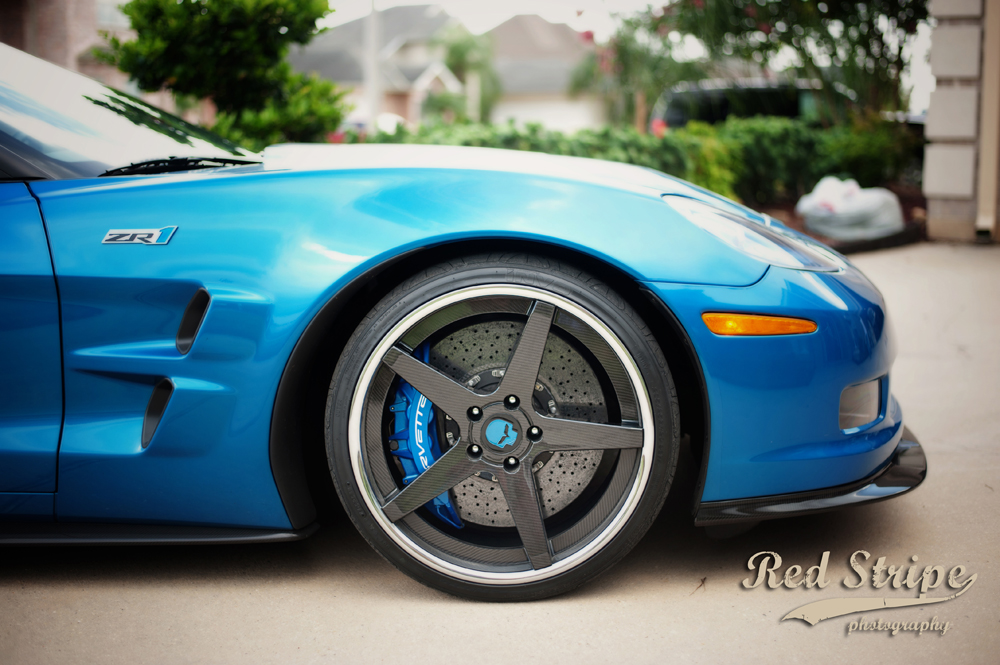
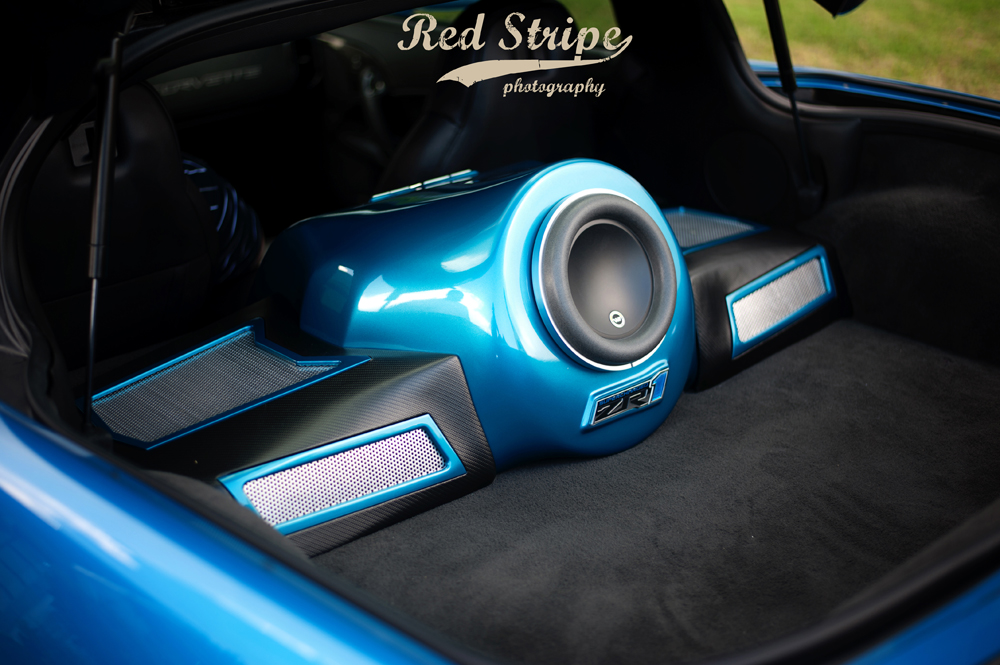
Went back to visit my family in Louisiana this past weekend; I always have a good time when I’m back there. There’s always something new with the family that we’re able to catch up on, or a new eatery that just opened up to check out. Never Trust A Skinny Food Critic blog has the scoop on the places we ate out at. My blog is mostly about cars/photography however and if you’ll remember, I’ve done a post in the past on my brothers ZR1. I had the pleasure of shooting the ZR1 again, but this time the car is vastly more improved and with updated modifications. I’m really impressed by the looks of the car and how the subtle changes really changed the previous stock ZR1. I didn’t get to drive the car this time; my brother was always in a hurry hence the quick photo shoot in the driveway. It’s too bad too because I had a sweet spot picked out in my mind for the shoot. But these things happen and there just wasn’t enough time. I did the best I could though to show the beauty of this ZR1. Hope you guys enjoy.
-RSP-
One of the reason we were in a hurry…see the rain clouds? I thought it would have been kinda cool to do a photo shoot in the rain but my brother wasn’t having it.
I give that ASS 4 thumbs up!!
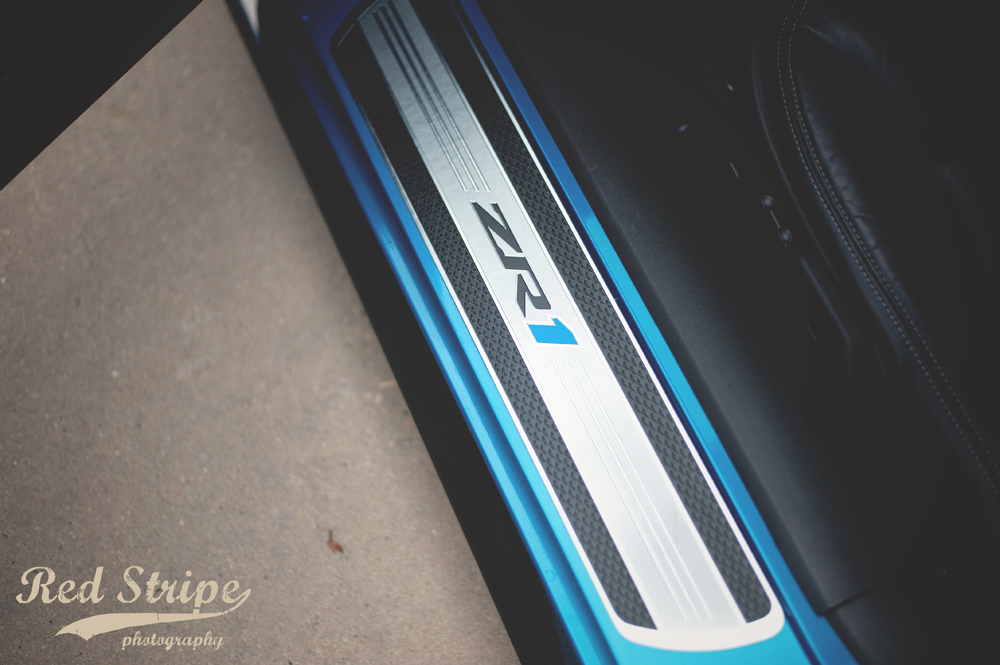
The door sill reminds you that you’re stepping into a ZR1
I was told it would happen when I upgraded my Mustang from a 6 cylinder to a V8. I was told it would happen when I got my first Corvette (1984 C4 with 205 hp). I was told it would happen when I got my second Corvette (07 C6).
And I was sort of told that numerous years ago by an Air Force pilot. I didn’t believe it each time.
No one can fault me, except some “car purists”, for taking the 250 straight 6 motor from my Mustang and replaced it with a V8 302 bored .030 nor when I attempted to increase the HP in my C4 Corvette from 205 to 245 with a new fangled intake (never actually took place). Those were pretty understandable upgrades considering the 250 in the Mustang had no get up and go (more like lay down and won’t) when the AC was on. For that matter why would ever limit a Corvette to 205 hp?
Now the C4 is gone but the Mustang puts out about 300 hp and the C6 is at about 420. I remember saying, “400 hp? That’s plenty for me!!!” when I bought the C6. And it should be. I’m certain that this SHOULD be ‘true’. But why then, do I have a set of 351 Cleveland Cobra Jet heads sitting in the garage for the Mustang. And why am I pricing superchargers for the Corvette?
I started thinking about this driving the C6 on my way to work today, recalling back when the Mustang was 195 hp and the 84 Vette was just 10 more than the Stang and wishing I had more. As I stepped on the throttle entering the Interstate, I thought to myself, I which I had a bit more power now. That’s just plan crazy talk!!! Just a year ago I was happy with the C6’s power and now its like… yeah its powerful, most powerful in the HOA I bet (why didn’t I just say “neighborhood”?). What happened?
What has happened is that I drive the Vette daily and it as become common place to have that power at a bend of my right ankle. I am sure that if I drove a Toyota Corolla every day and took the Vette out on the weekends, I would still be in awe of the power. I’ve just come so accustom (not complacent, mind you) to driving the car that it doesn’t seem extra ordinary (although intellectually I know that 400 plus hp is no joke).
That doesn’t explain the desire to upgrade the Mustang though, does it? So what does? I think that rational here is more rooted in my own attachment to what the last 60’s and 70’s muscles cars should be. But still when I’m driving it I wish for more power. You understand that don’t you? When you look at a 1969 Mustang and it has its original 6 cylinder in it, you say…”That’s nice. Its all original.” However when you see a 1970 Mustang Mach I with its massive engine…you say…’WOW!!! F-ing A that’s what I’m talking about!!!!” So it’s some of that for sure.
So here is where I am with my cars and thinking about it took me back to one of my military supervisor. He was a LT Col and was one of the few that flew the SR-71 for a living. He shared a story with me about flying a mission and on the return trip received a warning light on the instrument panel. This required him to have to slow the aircraft down bit. He said to me, “…and I thought GREAT it’ll take forever to get home at only Mach 2. I realized how relative speed it was.”
Thanks for reading and keep it under Mach 1. (Yes I’m sure that’s enough power…perhaps.)
Meanwhile, manual-shift enthusiasts are upgrading to modern units packing more heavy-duty horsepower capacity—and more gear ratios.
“The generation that is now in their 60s can afford to build the cars that they wanted to build when they were in high school,” said Dick Hill, sales manager for Centerforce Clutches in Prescott, Arizona. And while those folks are not usually looking to build a race car, “they do want a four- or five-speed manual transmission,” he said.
More surprisingly, the trend extends beyond muscle cars and into traditional hot rods as well.
“I have friends who are building Deuce roadsters and they are putting LS motors in them, with a five- or six-speed manual transmission,” Hill said. “There are people who put Cadillac V-8s in 1949–1951 Mercs, and they want a stick. They want a three-pedal car. So that, too, is contributing to the growth of the high-performance clutch market.”
Hot rodders who already own or have owned multiple cars are now looking for something different.
“It’s like the people who buy their first Harley, they want it with every doo-dad they can get, where older bikers are turning back to the Knucklehead or even Flathead motors,” Hill said. “It’s the same with the hot rodder who already has two or three or four toys in the garage. The newest toy is going to be a stick car. And it’s for the same reason that someone will buy a brand-new Camaro, put 1,000 horsepower in it, and drive it on the street while blowing cold air and playing tunes. They want a manual not because they’re going to race it, but because they can have it. That’s what we hear all the time: ‘Because I can.’”
Rating the Ratios
American Powertrain of Cookeville, Tennessee, sells a broad range of high-performance drivetrain components, from complete crate engines to driveshafts and pedals. The company also distributes Tremec transmissions.
“The hot market right now is for the Magnum six-speed in a classic muscle car,” said Gray Frederick. “The Magnum is Tremec’s replacement for the T-56 is the aftermarket version of what you would get in a new Shelby GT500 or Camaro SS.” Frederick added that people are putting them into classic Mustangs Cougars, Camaros Firebirds, Barracudas and Challengers.
“The cars that people spend the most money on are the cars that [are] getting Magnum six-speeds,” Frederick added.
The Magnum is available with two sets of ratios, with the closer-ratio unit being the more popular of the two.
“The wide-ratio box has a 0.5 overdrive, which is very tall; a lot of engines can’t pull that much overdrive,” Frederick said.
But when it comes to overdrive, isn’t more better?
“That’s a myth,” Frederick said. “You can say, ‘Alright, I’m at the ragged edge of my cam, where if I’m on flat ground I can hold 70 mph all day.’ In a perfect world, that would be great. [I]n the real world, at some point you’re going to have to slow down for construction, and then speed up again; or you’re going to hit a rise, or something else that causes your engine to run out of breath. [T]hen you’re going to have to shift and that’s what you’re trying to avoid.
“You want to put it in sixth gear and leave it sixth gear,” he continued. “You don’t want to run down the highway at your cam’s peak performance, which would be 3,000–4,000 rpm. But you do want an rpm where your engine can pull your car up hills, and pass without dropping a gear. If every time you put your foot in the gas the engine lugs and you have to shift, that becomes very inefficient. We’re helping the customer understand that, even on the highway, you want to stay in your powerband. Otherwise the overdrive doesn’t do you any good.”
Frederick recommends the wide-ratio unit mostly for torquey big blocks.
“A Pontiac 455 will pull a stump out of the ground at 800 rpm; it doesn’t have trouble pulling a car at whatever rpm you’re running,” he said. “A Mopar 440 and some other big blocks with a lot of low-end grunt can usually handle the taller overdrive, too. And of course we’re dealing with a lot of electronically fuel-injected (EFI) engines now, and most of them have computers that can cope with low rpm very well.
They can retard the spark, they can meter the fuel differently, they can do all kinds of things.
“We help the customer choose a rearend ratio and a gear set that’s going to give them the best performance, from top to bottom,” Frederick said.
Pedal Pressure Another concern, according to Hill of Centerforce Clutches, is the physical effort once associated with a high-performance clutch.
“Our customers all ask, ‘How stiff is the pedal?’” he said. “That’s why we’ve been very successful, whether it’s a single-disc clutch for mild upgrade vehicle, or dual-disc unit that can hold 1,300 lbs./ft. of torque, we’ve been very successful in making them streetable.”
The average consumer, Hill said, could climb into a car with a Centerforce dual-disc clutch, push the pedal to the floor, and not realize that the car was modified.
“[T]he person who has a $75,000 Camaro or Corvette wants race-car performance without the race-car effort, so this is pretty significant,” he said.
Still, selecting the optimal clutch for any particular application is a complex task best left to experts.
“There are different linings and different friction materials on the pressure plate,” Hill said. “Heat is a factor. The first thing you have to know is how the vehicle is going to be used. Drag racers realize they are going to drive their car until they break it, where hot rodders don’t beat their cars up as bad. They are very proud of their cars and they want to drive them, not break them. And unless the car has been tubbed, a street machine generally runs smaller tires, so you want to tune the clutch for that.”
McLeod Racing of Placentia, California, offers its RST and RXT Street Twin clutches, both double-disc units that hold up to 1,000 horsepower, with the pedal pressure of a stock clutch, said President Paul Lee. Contributing to this low effort—and to easier installation—are McLeod’s hydraulic release bearings, “which fit most applications, replacing worn and/or outdated mechanical linkages,” he said.
“We’re selling more clutches for vehicles from the 1960s and 1970s, and installing a new hydraulic clutch in one of these cars can significantly reduce pedal effort,” said Rich Barsamian, national sales manager for Advanced Clutch Technology (ACT) in Lancaster, California. The company also offers a wide range of clutches for GM, Ford and Mopar applications, each rated for torque at the crankshaft.
When installing an aftermarket clutch, Barsamian suggested, “be sure to use the right amount of lube on the input shaft—it is possible to use too much. Be sure parts are free from dirt and oil, and washed in a non-petroleum-based cleaner such as acetone, alcohol or brake cleaner. Be sure to follow the correct torque and tightening sequence when installing the clutch cover—and do not use impact tools.”

 on and off with the flick of a switch? Many gearheads have had that dream ever since it was seen in the Mad Max movie in 1979. The aftermarket was slackin’, but 34 years later, Procharger has made it real. Or close.