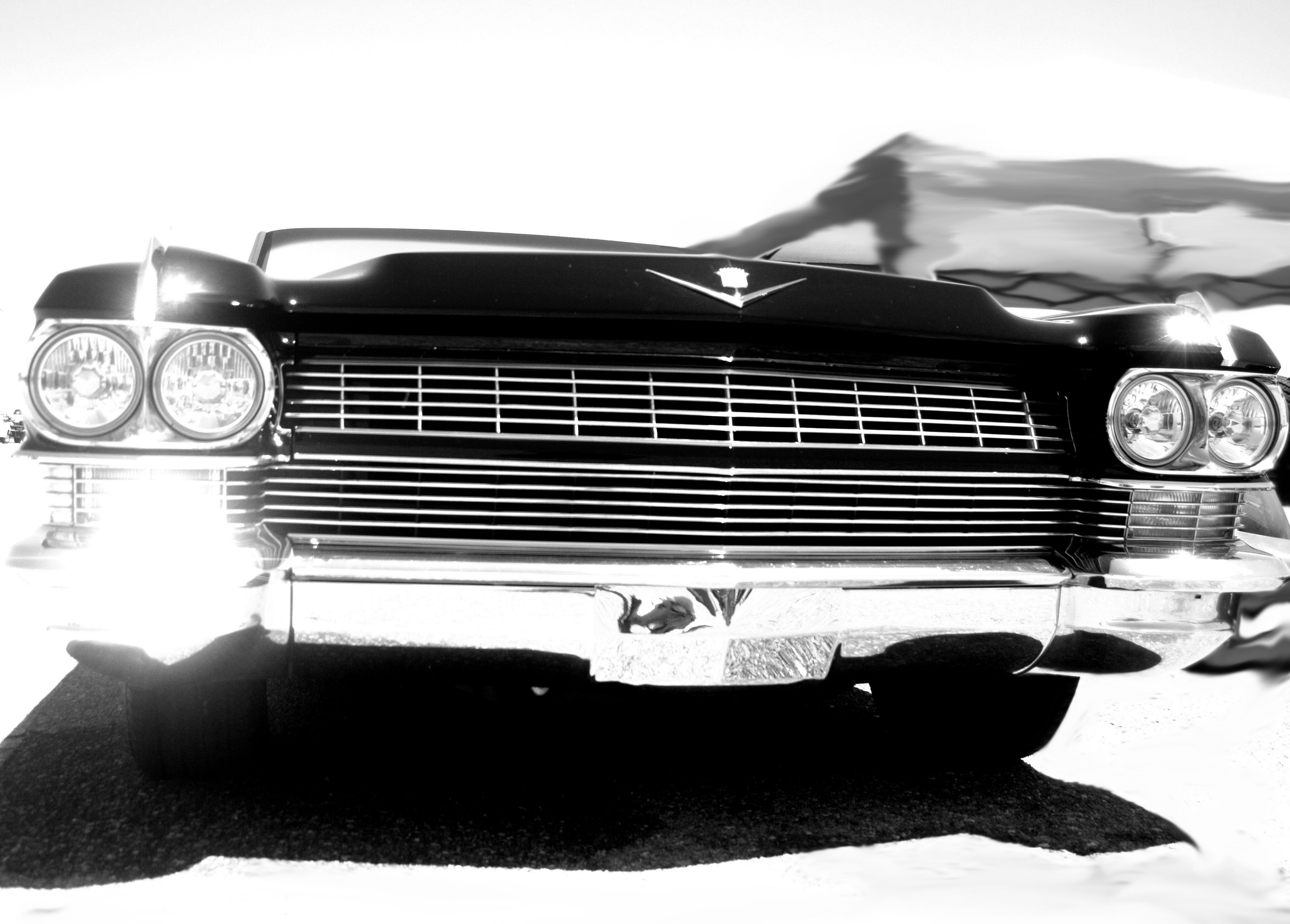
With the upcoming release of the Shelby GT500 Super Snake many people will have an opportunity to put on of these limited edition Shelby’s inside their garage. It’s quite the opposite for the 1967 Shelby GT500 Super Snake as the person who wins this ebay auction for the only 1967 Shelby GT500 Super Snake ever produced will have the ultimate limited edition Mustang. The 1967 Shelby Super Snake sports a 427ci V8 with 520 horsepower, a 170 mph top speed and unique triple stripes. The ebay auction is set to end in a week. Check out the pictures after the fold.
People love to talk about car sounds. We even mimic them. They can bring back memories of a car you or a family member owned. They can refresh visual memories of a race you attended or even participated in. They also bring back memories of a not so nice incident.
I can recall each sound in separate wave lengths in my first car accident, I was actually on my way to take my drivers test. I was driving my father’s brand new Ford Granada (he worked at a Ford dealership as body shop manager). The car was totaled, the other driver ticketed. A quick car swap and I went on to pass my test.
There are a few more sounds I remember. I remember my high school buddy’s 1973 Mach I, normally as he dusted me in my ’66 Chevy Impala an awesome noise that Mustang made. There was there the sound of the V8 under the hood of my Chevy – smooth but still throaty. (I don’t know if that’s even a work..but I’ll hustle over to Wikipedia and add it.)
But the other day was watching one of the Jason Borne movies and of course the there are the normal car chases. He was driving a little mini cooper and within all the metal crunching and tire squealing, there was one sound, at pause in the chase when he shifted that Mini and the sound the transmission made, triggered a memory.
In 1982 I was stationed in Germany and when I eventual got my European drivers license, the first car I could afford was a 1970 European Ford Escort. It was a 3 speed manual, shift on the flour and the sound of the transmission shifting in Jason’s Mini Cooper brought back that memory of my first European car.
My First European Car
Of course it didn’t have the pep that the Borne Cooper had, but it got me around.
Post up a note about a car sound that sparks a memory for you. Best one wins a free gift.
Coming up will be a series of posts as I rebuild the original 3 speed transmission. This is the original 3 speed transmission from my 1970 Mustang. I’ve replaced it with a rebuilt 1965 4 speed transmission from a Shelby Mustang. (See that in a post coming up.)
I’ll start the tear down after the Christmas holiday.
The Edsel. Name sake for Henry’s son. Touted as “ugly” and a failure. I disagree.
I think they were great and I plan on own one at some point. ( I was pretty close earlier this year – just missed one at an auction.) There is just something about tooling around in one of those large and long 4 door land yacht. Anyway..one day I will, if I just borrow one for a week.
So in the last year of the Edsel what engines were available?
The car came in 4 configuration, body-wise. A 2 door sedan, a 2 door convertible; a 4 door sedan and 5 door wagon, but only two engine options.
Your two choices were of the V8 and straight six variety.
Ford‘s 292 was the V8 power plant . It sported overhead valves, an iron block and hydraulic lifters. The compression was ratio 8.8:1 and with a bore and stroke of 3.75 x 3.60. It came with a 2 barrel carb – model B9A9510-A. Interesting the block and heads were painted black and the value covers and air cleaner were red.
There was the option inline (straight) 6 cylinder. That too had overhead valves and an iron block. Bore and stroke was 3.62 x 3.60 and compression ratio 8.4:1. It displayed 223 cubic inches with 145 horse power. It was topped with a 1 barrel carb, model B9A9510F. It had the same paint scheme as the V8 but was considered a “delete” option in the Rangers series.
223 Straight (Inline) 6 cylinder with the proper paint scheme
Add 2 more cylinder and buy an extra can of paint for additional valve cover and you'll have this 292 with the proper paint.
Hope everyone has recovered from heavy eating and traveling, I know I need to rest up before Christmas, maybe even drop a couple of pounds ahead of time.
I’m also to attempt to meet my goal of 500 posts before the end of 2011. (Yes this one counts).
I have a couple of contests coming up with some auto related DVD’s to give away and some a couple of parking lot finds, and a feature car or two.
Sergio Scaglietti held a hallowed place in the house of Ferrari.
One of Enzo Ferrari’s most trusted contributors, Sergio Scaglietti, has died at the age of 91.
The famed designer and custom car builder died Monday.
Scaglietti opened a repair shop across the street from the Ferrari works in Modena, Italy. Soon, he was repairing Ferraris and later began designing some of the automaker’s most storied models. He is credited with the 1958 Ferrari 250Testa Rossa and his Carrozzeria Scaglietti built some of the most famous custom-bodied Ferraris, including the 250 California and 250 GTO, which were designed by another longtime Ferrari associate, Pininfarina.
The entire house of Ferrari was in mourning following Scaglietti’s death.
In a statement on Ferrari’s Web site, Enzo’s son Piero Ferrari, said Scaglietti had a special place in his heart.
“He was one of my father’s best friends. He was next to me with Marco Piccinini the day my father died and stayed with me the whole night until the funeral. I loved him and he was a very important part of my life.”
Chairman Luca di Montezemolo said Scaglietti left an indelible mark on the automaker.
“Today is a sad day for Ferrari. We lost a friend, a travel companion, a man who had his name forever connected to the Prancing Horse,” di Montezemolo said. “Sergio Scaglietti leaves behind the legacy of an artist who, with his talent, created some of the most beautiful cars of our history. (Those who) had the luck to know him like I did will also remember him as a straightforward and honest man, completely dedicated to his work. We will miss him.”
Ferrari honored Scaglietti by naming its 612 grand touring model in tribute to Scaglietti.
Everybody knows that saying “I’ve died and gone to heaven”, and this applies to most enthusiasts in this junkyard full of old decrepit Ford Mustangs. Especially, the project guy that has an old classic sitting in the garage. I’m sure it could go either way, though, as some might consider this a sore sight with so many wrecked and rusted ponies. This is the Colorado Mustang Salvage Yard.
Soooo, anybody down for some campin’?!
Colorado Mustang Specialists, Inc. began in a two-car garage in 1972. Mustangs were as numerous as hippies on a Boulder park lawn, easy to buy, fix and sell. So, a would be University of Colorado student found a lucrative way to pay his rent and tuition. After graduation the diploma went in a drawer and the horsing around got serious. Wrecked, junked and abandoned Mustangs were cheap and plentiful, so the collection started that eventually led to the worlds largest Mustang salvage yard.
Most recent and exciting to us is the addition of modern fuel injection conversions, for 64-1/2 to 85 models. These conversions and related parts let the novice enthusiast bring his early Mustang into the new millennium with a computer driven, fuel-injected, V-8 power train, meeting todays standards without changing the Mustangs classic design. We predict these conversions will open a fun and exciting new era of Mustang enthusiasm.
One of my regular readers, Bill, posted the following question in response to the piece I wrote on Chevy engines. Bill asked…
“No 454 V8 in 1971? I guess that motor came later. ..”
That get me to thinking so I did a little more research. The references I’m use are “Ultimate AmericanV-8 Engine Data Book” by Peter Sessler; “Standard catalog of American Cars” by John Gunnel and “110 years of the American Auto” by James Flammang and Auto Editors of Consumer Guide. I try not to get too much from the Internet at large.
Interestingly enough the 454 is briefly mentioned in the Ultimate American V-8 Engine Data Book, but there aren’t many details. That reference shows that the 454 was available in 1971 as a 4V producing 365 horse power. It doesn’t show under any model just as a general option for Chevy’s. I’m assuming it was just a 400 block with a different bore and stroke.
The 454 was developed by 1970. It’s bore was 4.251 in and had a 4 inch stroke (where as the 400 had 4.251 in bore and a 3.75 stroke). There were other version in 1970 and 1971, designated as the LS5. This version of the 454 was used in the 1970 and beyond in Corvette for one instance and was used in Chevelle.
Interesting that it isn’t referred to in the mentioned references for 1971 year.
Hold the presses!!!!!
It appears that in the reference “Standard catalog of American Cars” by John Gunnel that the 454 was left out off the comprehensive listing of engines for 1971. However, the 454 was use in the SS version of the Monte Carlo – 1,919 were produced. For the Chevelle 80,000 were sold with the SS badge of those only 19,992 were with the 454.
1917 Chevelle SS 454
1971 Monte Carlo SS 454
And in this reference I found the answer to a question I’ve had for some time. About 5 years agoing I was at a car show and ended up talking to a guy with a 1971 Nova SS. It had a 454 as the power plant between the shock towers. However there were 7,015 Nova SS packages sold, none had the 454 as the option.
There is a bit more to the story of the Cricket. Chrysler thought that since GM had purchased Holden and Adam Opel, they should do a ‘me too’ and buy the Rootes group. This consisted of Talbot, Hillman, Simca, and Sunbeam.
The reality is Chrysler was left with a Dog of a car company. They thought the Cricket might catch on due to its image as a gas miser, but it really wasn’t too great on MPG. The build quality was awful, and customers found that the other MOPAR ‘captive import’, the Dodge Colt built by Mitsubishi, was a terrific car with great MPG, and priced a bit cheaper.
One great thing did evolve from the Rootes group for Chrysler; the Dodge Omni and Plymouth Horizon. These were billed as America’s first FWD 4 cylinder car that could compete with imports. Basically, it was a Talbot Horizon that had been on the market in the UK for many years. Chrysler did do dome re-engineering for the US market by adding a FWD version of the bullet proof Torque Flite auto trans (A413), and used VW Rabbit 1.7l 4 cylinder engines rather than the ‘shake and bake’ Peugeot motor in the UK version. Omni and Horizons were a hit, and reasonably reliable (my first new car was a 1982 Horizon TC3 that was reliable to 120K miles and then fell apart).
Lee Iacocca ended up giving the Rootes group away to Peugeot in the late 1970s in exchange for some stock and 4 cylinder engines for the Europe marketed MOPARs.
I’ll stop here so I do not go onto the era of the great K CARs HA HA.