Well I’m beginning to think that my local grocery store is really a car show 7 days a week!!!
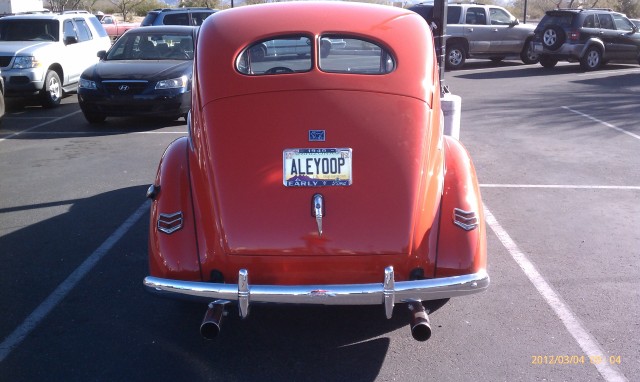
Case in point is this ’39 Ford coupe I saw over the weekend.
Great Hub Caps, Great Paint.
You’ve got to love that split rear window.
Pretty stout looking tail pipes.
Besides the tail pipes I’m liking the chevron tail lights.
1939 brought hydraulic brakes to the Fords for that year. Ford produced 487,031 cars that year, coming in second to Chevy.
Love the rolling fenders and the dog dish hup caps with the V8 log pressed into the centers.
Love the grill and the V8 and Ford badges.
You can't tell from my 'most excellent' photos, but there is a huge difference in the width of the rear vs. the front.
The V8 engine was the Flathead, which was originally developed in 1932. For 1939 the flathead was the V8-91A, compression increased to 6.15:1, power rose to 90 hp.
I ran across this on Classic Recollections. I’m not a Aston guy, but this DB Mark III is pretty nice. The owner did a lot of work on this thing. Nicely done! Oh, but cleaning those wire wheels…..ya killin’ me!!
I thought I’d share the an interview of Ed Pettus (previous owner of this unique vehicle) conducted by Dave Rasdal in is column “Ramblin'” in the Cedar Rapids, Iowa Thegazette.com. I’m interested in his next project.
The Crow Lakester
When Ed Pettus finished building his bullet-shaped Lockheed Lakester a year ago, he didn’t plan to sell it. But, after a whirlwind tour of the car that’s a cross between a jet airplane, a Bonneville Salt Flats racer and a 1930s biplane, he changed his mind.
“I do all of these projects and when I’m done, what do I do?” says Ed who with son Eddie Pettus Jr. has Eddie’s Rod & Custom in Cedar Rapids.
The Lakester, which I wrote about last July, is built around a wingtip gas tank of a 1950s Lockheed Super Constellation and has a steering yoke from a 1948 airplane. Parts came from 1930s Packards, a 1940 Ford tractor and a 1959 Chevy pickup. It has a turbocharged Toyota engine.
From shows in Cedar Rapids and the Quad Cities, it went to Chicago’s World of Wheels, a two-month stay at the Experimental Aircraft Association museum in Oshkosh, Wis., and on display at El Mirage near Long Beach, Calif., where dry lake bed speed runs originated.
“I thought, you know, after that I’m going to take it home and put it in the garage,” Ed says.
But, as a fan of the famous Barrett-Jackson vehicle auction in Arizona, Ed inquired about selling the Lakester. Told it was too late, he sent information anyway and was surprised to become a last-minute entry. It went on the block Jan. 21.
But, this auction doesn’t allow sellers to set a minimum price — if the high bid is $100, the car sells for $100.
Ed had insured the Lakester for $100,000. Bidding opened at $10,000.
“We were a nervous wreck,” he says, referring to his wife, Kathy, and friends in attendance.
Bidding quickly rose, though, to $100,000. Two bidders pushed it to $170,000, the winner from Georgia adding it to his collection.
“We feel so blessed with what we got,” Ed says. He’ll use the extra funds to retire the mortgage on Ellis Boulevard NW property (home and vacant lot) destroyed by the Floods of 2008.
Unsure about what they can do with the property, Ed, 60, isn’t waiting around for another hot rod project. All he says is that it’s a unique truck. “Let people wonder.”
Ok, so one engine plant is located in Canada and the other Ohio. What else is different?
The 351 Windsor (biggest displacement of the Windsor family – which included the 289 and 302) had a beefier block than the Cleveland, which in theory allowed for more abuse and longer life-span.
The Windsor also came first in the history being used from 1969 to 1998.
The Cleveland was used from 1970 to 1974 (much, much shorter run), with 1971 bringing 351 C Cobra Jet.
Unlike the Windsor the Cleveland had canted multi-grooved valves. It also required larger rounded intake and exhaust ports.
There is another major difference and that was how the engined were cooled. No we aren’t talking water vs. air (these weren’t VW engines) we are talking about water flow.
Like the 289 and 302 the 351W used a front cover and water existed the intake manifold face of the cylinder head through intake manifold to the radiator. The 351C don’t have the front cover. The block is extended and the covered with a flat stamping. Water existed the combustion face of the head and into the block and then to the radiator. This is important to note, particularly for me. Why:
The Cleveland and Windsor heads are interchangeable only with modifications to the water passage. I currently have a set of 351C Cobra Jet heads to put on my Windsor family 302. I’ll have to have those mods done when I have the heads rebuilt.
Not the same location as the 302 Windsor.
There you have the basic differences between the Cleveland and Windsor families.
I have a Ford and as I’ve said before, though the years (ok….40’s, 50’s and 60’s) they produced some of the more interesting cars with some of the most powerful engines. Of those engines the Cleveland and the Windsor were major players.
I’m not alone thinking that the only real difference between the two were the names each being made in the plant they were named after. The Windsor was named after the Essex Engine plant in Windsor, Ontario and the Cleveland Engine Plant in Ohio.
1914 Photo of the Essex Engine plant in Windsor, Ontario
Cleveland Casting Plant where the Cleveland engines started.
Totally different plants and countries about the only they had in common was displacement.
Right on the verge of the gas crisis, the ’74 models were a mixed bag of old school horsepower and new school power choking fog reduction hardware. This Impala was in fact still a V8 with the power of the a 1960’s 6 cylinder.
Now I love the Impala models and if you’ve read a recent post I wrote I think 4 doors are under valued and with the right tweaks can achieve the power desired to make them a muscle car.
This Chevy was sitting outside a local CVS store with a for sale sign.
4 door with stamped steel wheels and poverty hub caps
I’m not sure what year it. You couldn’t really tell by the headlights or tail lights. But one doesn’t often see one of these in this condition too often.
One of a kind.
Back of the Bun!!
The interior was set up like a tour bus.
What I can tell you is that the big dog is resting what appears to be a Chevy Dually pick up truck bed. According to the sign it’s powered by a 5700 6.0 Vortech Chevy engine.
This one is for the C4 crowd (You digging this one Tony Z.?) There will be two winners one from Corvette Pals and one from my blog. Here is what I’m looking for. I use to auto cross my 1984 Crossfire (still do SCCA with my C6) and I love to see the C4 in action.
So post of a video of your C4 in action (action photos are ok too!) – Nothing illegal (snicker) or unsafe, mind you. Burn outs, auto cross, drag strip…Looking for some action shots. Post them up at https://www.facebook.com/pages/Average-Guys-Car-Restoration-Mods-and-Racing/185827701454279 and mention The Average Guy’s Car Restoration, Mods and Racing blog.
OH…what’s the prize? How about a 1984 Red Corvette promo model in the original box or a 1984 Silver C4? These are the model cars the dealerships give away. Can’t win if you don’t play…can’t win if you ain’t got a C4!!!! Game on!!!
1984 Silver C4 Promo Model - Yes those are Mustangs in the back ground!!!