Transitioning to Modern Transmissions Prt 2

Posted By John Katz, June 25, 2012 in E-News, Engine & Drivetrain

From www.hotrodandrestoration.com

Stick Shifting

Meanwhile, manual-shift enthusiasts are upgrading to modern units packing more heavy-duty horsepower capacity—and more gear ratios.

“The generation that is now in their 60s can afford to build the cars that they wanted to build when they were in high school,” said Dick Hill, sales manager for Centerforce Clutches in Prescott, Arizona. And while those folks are not usually looking to build a race car, “they do want a four- or five-speed manual transmission,” he said.

More surprisingly, the trend extends beyond muscle cars and into traditional hot rods as well.

“I have friends who are building Deuce roadsters and they are putting LS motors in them, with a five- or six-speed manual transmission,” Hill said. “There are people who put Cadillac V-8s in 1949–1951 Mercs, and they want a stick. They want a three-pedal car. So that, too, is contributing to the growth of the high-performance clutch market.”

Hot rodders who already own or have owned multiple cars are now looking for something different.

“It’s like the people who buy their first Harley, they want it with every doo-dad they can get, where older bikers are turning back to the Knucklehead or even Flathead motors,” Hill said. “It’s the same with the hot rodder who already has two or three or four toys in the garage. The newest toy is going to be a stick car. And it’s for the same reason that someone will buy a brand-new Camaro, put 1,000 horsepower in it, and drive it on the street while blowing cold air and playing tunes. They want a manual not because they’re going to race it, but because they can have it. That’s what we hear all the time: ‘Because I can.’”

Rating the Ratios

American Powertrain of Cookeville, Tennessee, sells a broad range of high-performance drivetrain components, from complete crate engines to driveshafts and pedals. The company also distributes Tremec transmissions.

“The hot market right now is for the Magnum six-speed in a classic muscle car,” said Gray Frederick. “The Magnum is Tremec’s replacement for the T-56 is the aftermarket version of what you would get in a new Shelby GT500 or Camaro SS.” Frederick added that people are putting them into classic Mustangs Cougars, Camaros Firebirds, Barracudas and Challengers.

“The cars that people spend the most money on are the cars that [are] getting Magnum six-speeds,” Frederick added.

The Magnum is available with two sets of ratios, with the closer-ratio unit being the more popular of the two.

“The wide-ratio box has a 0.5 overdrive, which is very tall; a lot of engines can’t pull that much overdrive,” Frederick said.

But when it comes to overdrive, isn’t more better?

“That’s a myth,” Frederick said. “You can say, ‘Alright, I’m at the ragged edge of my cam, where if I’m on flat ground I can hold 70 mph all day.’ In a perfect world, that would be great. [I]n the real world, at some point you’re going to have to slow down for construction, and then speed up again; or you’re going to hit a rise, or something else that causes your engine to run out of breath. [T]hen you’re going to have to shift and that’s what you’re trying to avoid.

“You want to put it in sixth gear and leave it sixth gear,” he continued. “You don’t want to run down the highway at your cam’s peak performance, which would be 3,000–4,000 rpm. But you do want an rpm where your engine can pull your car up hills, and pass without dropping a gear. If every time you put your foot in the gas the engine lugs and you have to shift, that becomes very inefficient. We’re helping the customer understand that, even on the highway, you want to stay in your powerband. Otherwise the overdrive doesn’t do you any good.”

Frederick recommends the wide-ratio unit mostly for torquey big blocks.

“A Pontiac 455 will pull a stump out of the ground at 800 rpm; it doesn’t have trouble pulling a car at whatever rpm you’re running,” he said. “A Mopar 440 and some other big blocks with a lot of low-end grunt can usually handle the taller overdrive, too. And of course we’re dealing with a lot of electronically fuel-injected (EFI) engines now, and most of them have computers that can cope with low rpm very well.

They can retard the spark, they can meter the fuel differently, they can do all kinds of things.

“We help the customer choose a rearend ratio and a gear set that’s going to give them the best performance, from top to bottom,” Frederick said.

Pedal Pressure Another concern, according to Hill of Centerforce Clutches, is the physical effort once associated with a high-performance clutch.

“Our customers all ask, ‘How stiff is the pedal?’” he said. “That’s why we’ve been very successful, whether it’s a single-disc clutch for mild upgrade vehicle, or dual-disc unit that can hold 1,300 lbs./ft. of torque, we’ve been very successful in making them streetable.”

The average consumer, Hill said, could climb into a car with a Centerforce dual-disc clutch, push the pedal to the floor, and not realize that the car was modified.

“[T]he person who has a $75,000 Camaro or Corvette wants race-car performance without the race-car effort, so this is pretty significant,” he said.

Still, selecting the optimal clutch for any particular application is a complex task best left to experts.

“There are different linings and different friction materials on the pressure plate,” Hill said. “Heat is a factor. The first thing you have to know is how the vehicle is going to be used. Drag racers realize they are going to drive their car until they break it, where hot rodders don’t beat their cars up as bad. They are very proud of their cars and they want to drive them, not break them. And unless the car has been tubbed, a street machine generally runs smaller tires, so you want to tune the clutch for that.”

McLeod Racing of Placentia, California, offers its RST and RXT Street Twin clutches, both double-disc units that hold up to 1,000 horsepower, with the pedal pressure of a stock clutch, said President Paul Lee. Contributing to this low effort—and to easier installation—are McLeod’s hydraulic release bearings, “which fit most applications, replacing worn and/or outdated mechanical linkages,” he said.

“We’re selling more clutches for vehicles from the 1960s and 1970s, and installing a new hydraulic clutch in one of these cars can significantly reduce pedal effort,” said Rich Barsamian, national sales manager for Advanced Clutch Technology (ACT) in Lancaster, California. The company also offers a wide range of clutches for GM, Ford and Mopar applications, each rated for torque at the crankshaft.

When installing an aftermarket clutch, Barsamian suggested, “be sure to use the right amount of lube on the input shaft—it is possible to use too much. Be sure parts are free from dirt and oil, and washed in a non-petroleum-based cleaner such as acetone, alcohol or brake cleaner. Be sure to follow the correct torque and tightening sequence when installing the clutch cover—and do not use impact tools.”

Thanks for reading Part 3 coming up.

Transitioning to Modern Transmissions Prt 1

This is a great article.  If you are building a hot rod from scratch or you are taking your muscle car to a modern level  you will find some good information in this piece.  I toyed with the idea of putting a modern manual 5 speed trans in my 70 Mustang, but I opted for a rebuild Shelby 4 speed manual.  (Check out all 3 parts.)
Posted By John Katz, June 25, 2012 in E-News, Engine & Drivetrain
From www.hotrodandrestoration.com

Derided as “slushboxes” in the days when hot rodding was young, automatic transmissions have long since closed the performance gap and won the respect of (at least some of) the most dedicated lead foots. Today, even the fuel-economy advantages of the old-standard stick shift are more memory than reality, as the shiftless set has drawn even with, or pulled slightly ahead of, the shifters. Backing up these advances is a great deal of detailed engineering, especially of the electronic variety.

But a lot of it’s simply due to more gears—a wider range of ratios, allowing for relaxed, low-rpm cruising with peak torque still available on demand. About 10 years ago, a four-speed automatic with a lockup converter was the hot ticket to optimize performance with economy. Now the OEMs are building five-, six- and seven-speed automatics—and hot rodders want them, too.

Not that the shift-for-yourself crowd has been caught napping—six gears are now the required minimum in any respectable OEM performance car, and that’s left three-pedal rodders craving more ratios, too.

More Is Better
“Enthusiasts in every segment of the hot rod and muscle car markets are removing traditional three-speed gearboxes and replacing them with modern four-, five- and six-speed transmissions,” said Stanley Poff, who heads product and sales for TCI Automotive in Ashland, Mississippi. “As they experience modern overdrive automatics in their daily drivers, they become more inclined to want the same driving experience in their hot rods.”

TCI’s new 6x Six-Speed can be adapted to most GM small-block, big-block or LS engines; Ford small and big blocks; and Chrysler small blocks, big blocks and late-model Hemis.

“We build it in a modified GM 4L80E case that’s been machined to accept modular bellhousings, and we keep all of the Reid Racing bellhousings in stock,” Poff said. “We can put together a complete package for all of those applications, including the transmission, bellhousing, EZ-TCU electronic control, cooler, shifter (conventional and/or paddle-type), TCI transmission fluid and a dipstick.”

TCI currently offers the 6x in two models, rated for 850 and 1,000 horsepower, respectively. Models for 1,250 and 1,500 horsepower are in the works, according to Poff.

The market has also responded well to the company’s EZ-TCU, he said.

“It allows you to retrofit a modern electronically controlled automatic transmission, such as our 6x, or the GM 4L60E, 4L65E, 4L70E, 4L80E or 4L85E, to a carbureted engine, or an engine with a self-tuning EFI system such as the FAST EZ-EFI,” Poff said.

TCI worked with FAST to develop the EZ-TCU.

“It follows the FAST model of being extremely user-friendly and easy to install even by people who lack either tuning or electronics experience,” Poff said. “We sell a lot of EZ-TCU units to people who want to put a crate engine and electronic transmission in a classic street rod or muscle car.”

Pete Nichols, sales manager for Hughes Performance in Phoenix, pointed to the classic muscle car market, where “more and more people are building these cars with significantly higher-than-stock levels of horsepower and torque,” he said. “That requires a premium, high-strength aftermarket torque converter and transmission assembly.”

To meet these demands, Hughes now builds all of its GM 700R-4, 200-4R and Ford AOD transmissions with the upgraded, constant-pressure valve bodies.

“These valve bodies contribute to improved shift quality and more consistent shift timing, while reducing the possibility of premature transmission failure due to a broken or incorrectly adjusted throttle-valve (TV) cable,” Nichols explained. “The new design also eliminates a lot of the complexity and hassle associated with the TV system on these transmissions, so retrofitting them into older cars is easier than before.”

Hughes has also introduced a custom bellhousing system that allows builders to bolt the popular GM 4L80E behind a wide variety of GM, Ford and Chrysler engines without using an adapter. The company offers custom 4L80E options for applications producing 500–1,500-plus flywheel horsepower, and for virtually any popular V-8 engine.

Nichols emphasized the need to properly flush the transmission cooler and cooler lines before installing a new torque converter.

“Debris gets easily trapped in the old cooler and then it gets flushed out during the initial run-in period, inevitably working its way into the valve body, governor, etc.,” he said, adding that getting a new cooler is the best way to prevent debris-related failures.

Part 2 coming up.
Tim

Rotary Engine Part 2

Here is a quick run through of the combustion sequence for a rotary engine.


Thanks for reading

Tim

Rotary Engine Part 1

Rotary engines have always been a mystery to me.  Never understood them, no clue on how they worked.  Here is a great little vid on how it works.

Thanks for reading

Tim

Carburetors – Size Matters

You’ve build the engine block from the ground up.  You bored it, honed it and polished and ported it.  The goal – MORE POWER!!!  But you are going to defeat the purpose of all that work and $$$$ buy tossing the wrong size carb with the wrong size fuel line.

So I ran across the this chart that can help.

If the CID is                      Carb Size                                Fuel Line diameter

250 – 300                           480-600 cfm                                   5/16 ”

300 – 350                           600-350 cfm                                    5/16″ or 3/8 ”

350 – 400                            650-750 cfm                                    3/8″

400 – 500                            750-950 cfm                                    3/8″ or 1/2″


There is one other consideration and that is the capacity of the fuel pump, however that can be compensated for by using a fuel pressure regulator.

950 CFM Carb

Thanks for reading

Tim


FEATURE: 1978 VW Bus

This from Classic Recollections (http://classicrecollections.com/2012/07/16/feature-1978-vw-bus/).

I’ve never owned but  I have a brother-in-law who has restored a few – they weren’t show quality like this one but they were in fact fully functional.    Although WV buses required “frequent” attention, the repairs aren’t difficult, but I’m not sure the fun outweighed the trouble.

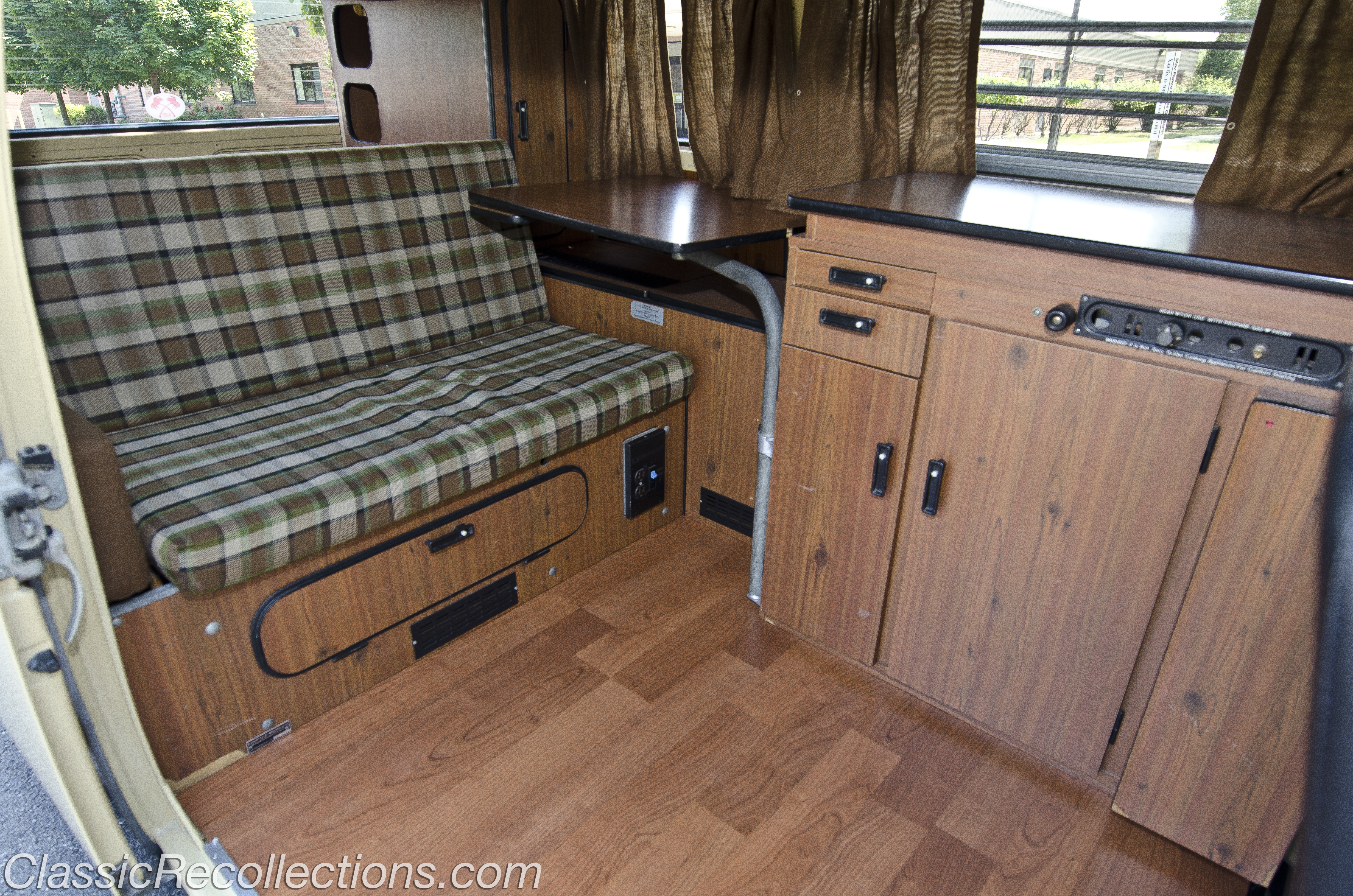
This 1978 VW Bus has undergone a 10 year restoration.

The first question most people are dying to ask when they spy Jack Connelly pull up in his 1978 VW Bus is, “Do you go camping in it?”

Jack Connolly has imparted his love of VWs to his kids: Anna and Jack Jr.

Who can blame them? For decades, these uber-functional hauling machines were the vehicles of choice for motorists who desired to get up close to the picturesque outdoors.

With their squared styling, compact rear-engine design and over-the-wheels driving position, these microbuses have interior space in overabundance. Add to this the Volkswagen camper model’s pop-up roof, and occupants are able to fully stand up.

**Want to know how Jack restored this roomy rolling classic? Head over to our full feature on the Daily Herald HERE**

________________________________________________________________________________________This 1978 VW Bus has been restored over a period of 10 years.This 1978 VW Bus was restored over 10 years.

This 1978 VW Bus has been restored over a period of 10 years.

Opening the side sliding door reveals the spacious interior that can accommodate all sorts of cargo.


Thanks for reading.

Tim

Formula 1 Engine calculations

I wanted to share something I did related to piston speeds. As you know Formula 1 is near the pinnacle of technology in engine development. Back in 2003, I read an article about how the BMW Racing team developed their engine. The article stated they were very proud that for the 2003 season, their engine was a 3 liter V10 design which had a maximum racing RPM of 19200 and the piston sustained a maximum piston speed of 40 meters per second (which equals 7872 feet per minute maximum). The article further stated their piston sustained a maximum acceleration of 10,000 times the force of gravity at maximum revolutions per minute.

I was always curious about the bore vs stroke for such a small displacement, high revving engine, but they always kept that secret. I grabbed my old Dynamics book and realized I could solve for bore and stroke by two methods, using angular velocity and again by piston acceleration.

Please note, I found a typo on Page 1. It says VA and VB are parallel, when clearly it should be written VB and VC are parallel.

Enjoy and discuss!

Posted Image

Posted Image

Posted Image

Posted Image

From Ted Yoder on ACE   http://www.arizonacorvetteenthusiasts.net/arizonavette/forums/index.php?showtopic=21192

Thanks for reading.

Tim

Engine Line Up – 1966 AMC

Often over looked is the first year AMC products.  AMC invested approximately 300 million dollars in  advanced engine designs, bodies and plant facilities as it prepared for the move from Nash Rambler hold over to AMC proper.

Of course the company was formed from Nash Rambler (AMC Rambler) in 1958 and eventually just American  Motors Corp.  So 1966 found a fair amount of “redesign” going on.   The available models for that year were:

Rambler American Rouge Series 01 (4dr w/V8)

Rambler Classic 770 Series 10 (2dr conv w/V8)  (4dr station wagon w/6cyl)

Rambler Rebel  Series (2dr w/V8)

Marlin Series 50 (2dr w/6 or V8) (My favorite besides the Javelin)

I love these cars. The two-tone paint is great. I love the yellow and black, blue and black and the silver and black combo.

Ambassador 990  Series 80 (4dr w/V8)

Rambler Ambassador 990  Series 80 (2d conv w/V8)

1966 Rambler Ambassador 990 Convertible

Rambler Ambassador DPL Series 80 (2dr w/V8)

Gone from the engine line up is the 196.5 6 cylinder overhead valve engine.  It was replaced with the 198.8 In Line Six. It was a cast iron block with overhead valves and a bore and stroke of 3.57 x 4.00 inches.  It displaced 198.8 cubic inches with a compression ratio of 85:1 and mustered up 128 hp. It was topped with a 1bbl Holley carb.  This was the base engine and all of the models could have been optioned with it.  But that wasn’t the only 6 banger the American 232 cid with produced 155 hp which sported a 2bbl Holley carb.

On the V8 side of things there was the 287 cid.  It was a cast iron block with overhead valves with a bore and stroke of 3.75 x 3.25 which produced a compression ratio of 8.7:1.  Topped with a 2bbl Holley (model 2209-2699) it made 198 hp.  The other option was the 327 cid that put out 270 hp and carried a 4bbl Holley on top.

New for that year was the 290 V8 (4.8L) it had a bore and stroke of 3.75 x 3.28  and with an iron block and overhead valves which produced 200 hp with a 2bbl plopped on top for 225 with a 4bbl carb.  Snap up the car with an original 290, only 623 of these engine were place in the 1966 models (all may the “American” models vs the “Classic” (those should have 287 instead).

The 290 used sparingly in the 1966 models.

The 327 was available in 1966. It was 5.4 liters with cast iron block.  The bore was increased over the 287 (they were similar set up) and it had hydraulic lifters.

The AMC 327 was similar to the 287, but displaced 327 cu in (5.4 L) due to the bore increase to 4.0 inches (102 mm). Unlike the 250, the 327 was available with hydraulic valve lifters.  The bore and stroke was 4.0 x 3.25  and topped with 2bbl carb it produced 250 hp.  Put the 4bbl option and you push it up to 270 hp.

I really these early AMC.

Thanks for reading.

Tim

CRUISE NIGHT: Downtown Barrington, Illinois

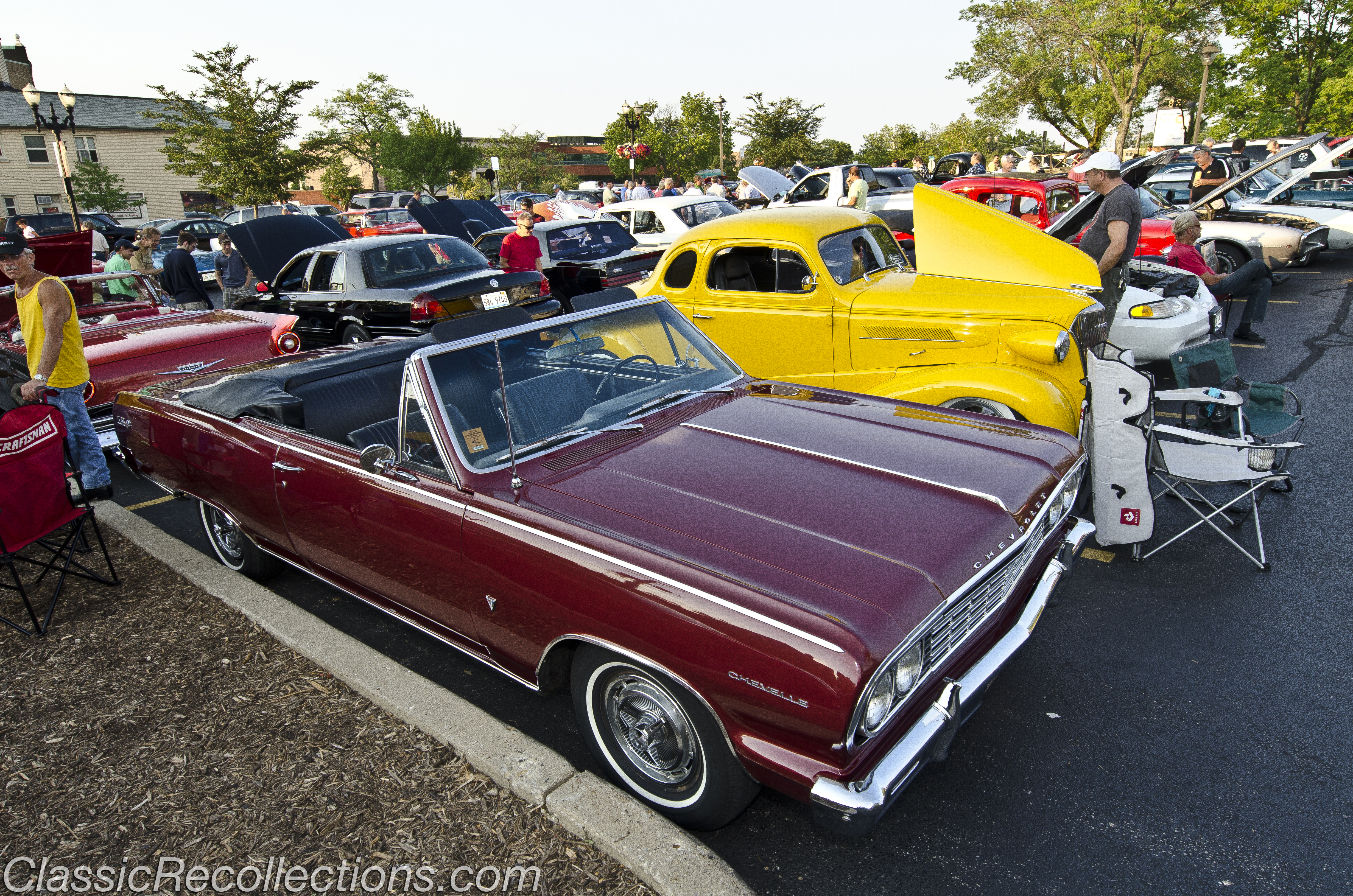
Downtown Barrington, Illinois's classic car cruise has been taking place for 9 years.Tucked away in the Northwest suburbs of Chicago is the quaint town of Barrington and every summer Thursday night, the classic cars come rolling in for the village’s weekly cruise. With its tranquil, tree-lined setting, easily accessible boutique shops and casual dining, this event is one draws automotive enthusiasts from all over.

Anne Garrett helps to oversee the downtown Barrington, Illinois classic car cruise night.

Anne Garrett

Anne Garrett serves as the Manager for Special Events and Marketing for the Village of Barrington and described to us how the cruise came to be.

“This year is our 9th year for the cruise, which got started in 2003. At the time, the village had been looking for ways to draw traffic and attention to the downtown area and knew a classic car cruise would be just perfect. Other neighboring suburbs had something similar so we did some research and determined we had what it would take to run a successful event. We settled on the South Cook street area and in all the years its been running, haven’t changed a thing.”

Anne informed us two village staff members and several members of the The Barrington Police will typically bring out a few vehicles to the classic car cruise.public works, as well as local law enforcement, are required to run the event.

“The Barrington Police will attend but it’s more of a public safety presence and a chance to interact with the local community.”

In addition, they also typically bring out vehicles from their fleet and allow spectators to get up close and personal with their high-tech cruisers. Volunteers from the Barrington Lions Club also help with the event.

Classic cars parked in downtown Barrington, Illinois for the classic car cruise. 2012“Four years ago we were approached by the group who offered their assistance. Every year since we’ve had 4 or 5 faithful volunteers help man the barricades and allow the cars to come in and out.”

Judging by the jammed lots, full of classic and custom cars, and the multitudes of owners and spectators milling about, it’s safe to assume the cruise has been a huge hit with the community.

“So far, the response has been tremendous. It seems every week people genuinely look forward to the event. They’re able to come early and go to the Farmer’s Market and then wander around the lots, checking out the cool classic cars. We rotate the onsite food venders and always have different entertainment so no two weeks are exactly the same.”

Classic cars parked in downton Barrington at the cruise. 2012

Expect the lot to be filled during the warm, cruising months.

The local businesses have taken notice of the increased foot traffic. Classic cars parked in downtown Barrington, Illinois for the classic car cruise. 2012

“We’re having more and more of our downtown merchants stay open late, which gives spectators many options for additional shopping and dining activities when they’re done seeing the cars. It really adds to the overall community feeling of the event and makes it a wonderful place to spend the evening.”

If you plan on attending the Barrington cruise and want to bring a four-wheeled relic, you’d better get there early.

“Our official start time is 6:30pm but the car owners will arrive and start cuing up around 4:30pm. Many of them want to make sure they get their ‘special spot’. Generally our end time is right at dusk, as the car owners don’t like driving home in the dark with their headlights on. We’ve been told they don’t like to run the risk of attracting bugs and having to put in the extra time cleaning them off.”

Classic cars parked at the 2012 downtown Barrington, Illinois classic car cruise.Each night throughout the summer has a theme, highlighting a certain brand, style or type of classic machine. While all are welcome, the themed vehicles are given special attention. Here is the schedule for the rest of the season:

July 19: 70’s Night
July 26: “Orphan” Cars
August 2: Mopar
August 9: Convertible
August 16: Sports & British Cars
August 23: Corvette
August 30: Trucks/ 4×4

** Want to know what events are taking place near you? Check out our Cruise Calender **

__________________________________________________________________________________

At the downtown Barrington cruise, you’ll see everything from an ultra-modern Fisker Karma to all your favorite vintage Detroit muscle machines.

Classic cars parked at the 2012 downtown Barrington, Illinois classic car cruise.

**All photos and content by Classic Recollections and may not be used without permission. 2012 © **

Classic cars parked at the 2012 downtown Barrington, Illinois classic car cruise.

Classic cars parked at the 2012 downtown Barrington, Illinois classic car cruise.

__________________________________________________________________________________

Classic cars parked at the 2012 downtown Barrington, Illinois classic car cruise.

Classic cars parked in downton Barrington at the cruise. 2012__________________________________________________________________________________

**All photos and content by Classic Recollections and may not be used without permission. 2012 © **

Steve’s C4 Update

I've been fiddling a bit with the Vette.  I have a few projects to do now that I've become a lot more familiar with the car in the last two and a half months.

Although the car sounds cool, the cheap aftermarket mufflers are completely rusted inside.  The baffles are all loose with lots of holes.  On the outside they look new.  They are the source of most of the rattles.

The lumbar supports on the sport seats don't work.  I can't hear the pumps run so inspecting electrics first on those.

Rear speaker amps are toast.  Expensive so it's not high on the list.

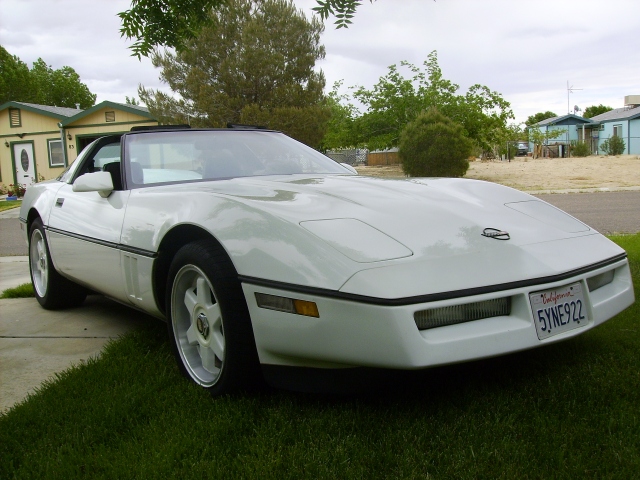
Steve’s 1990 C4

Tranny service due.  No biggie and not expensive.

PRNDL lights are out.  Not bad considering it's 22 years old and all other lights work.  I was amazed at the sheer number of lights inside.  Courtesy lights and mood lighting.  The interior alone must have 15 individual lights.

Drivers side headlight motor needs to be repaired.  It works most of the time. LOL.

It's a pretty short list considering the age.

It pretty much sits in the garage.  We are in the 100's (110 today) this week so it's morning and evening use.  The ac does not work but it still has the factory seals on the service ports so I'm hoping for good news there.  We do have R12 available here.  I unbolted the roof when I got it and it hasn't been back on since.  I always wanted a convertible and the coupe is a good compromise.

The most annoying thing about the car is the static electricity. It doesn't shock me or anything but dust sticks to it like glue and the California duster only moves it from place to place.  I never thought about a "plastic" body in that way.  The duster works just fine on my steel cars.