Dodging Bankruptcy and the Crusher

Dodging Bankruptcy and the Crusher.

Joe Greeves – July 05, 2012 10:00 AM

Image
Image
Image
Image
Image
Image
Image
Image
Image

(Editor’s note: Shortly after this article was written and printed in Auto Enthusiast (July issue), John Guarnieri was killed in a traffic accident en route to a show with his Dodge in tow. Our sympathies are extended to the friends and family in the loss and it was our privilege to share John’s car and passion with our readers).

Financial bailouts of automobile companies have been in the news but shoring up the auto industry is not something limited to recent times.

This beautiful 1955 Dodge Custom Royal Lancer is proof that sometimes the infusion of extra cash can produce striking results. Almost driven to bankruptcy because of poor sales in 1953 and 1954, Chrysler was saved from collapse by a $250 million loan from Prudential and the talents of automotive designer Virgil Exner. In 1955, a beautiful collection of cars across the board became the result that put Chrysler solidly back into the Big Three.

The redesigned 1955 Dodge emerged from the makeover as a truly representative car of the ’50s. Positioned between Plymouth andDe Soto in the Chrysler lineup, the Dodge sported a six-volt electrical system, kingpin/leaf spring suspension, and 15-inch wheels. Six adults could ride in comfort and the trunk could hold their luggage.

Over-engineered with 20-quart cooling systems and six-quart oil capacities (sixes as well as V-8s) the engines ran on low octane gas and were trouble free. They were good looking cars then and still are today.

Enter John Guarnieri, a retired police officer and lifelong Mopar enthusiast living in St. Augustine, Florida. John is an active member of the Ancient City Auto Club and has owned 64 vehicles over the years. His involvement with this beautiful example began moments before it was headed to the crusher!

In February 2004, he and a friend were on a parts run when they drove past a junkyard in Lake City, South Carolina, surprised to see a distinctive tri-colored Dodge being pushed inside the fence. Except for rusted floorboards from a failed heater core, the car was complete and the body was pristine. A six-volt battery and a gallon of fresh gas brought the 270 Hemi V-8 to life, convincing John that the car had potential.

He learned that the car had been carefully stored for more than 25 years by the grandfather and his son, but the grandson got involved with drugs and never paid the storage fees. Knowing that the Custom Royal Lancer was the flagship car of the Dodge line, John stepped up like Prudential a half century before, intent on saving the car. He wrote a check for the storage fee, paid for a South Carolina title, and took the car home. As an unexpected bonus, the dealer threw in a second ’55 Dodge as a parts car. In all, John acquired five parts cars during the almost four year restoration.

After trailering the car back to St. Augustine, John’s first step was to get the brakes working properly and exercising the engine. Several trips up and down the highway and two oil changes later, the engine stopped spewing black smoke, a sign that it was time for the full restoration to begin.

Recalling the process with a smile, John says, “It only took two days to tear the car apart and 3½ years to put it back together!” The five parts cars and new old stock items located on eBay gave John everything he needed to complete the project. He accomplished much of the work himself, overhauling the engine on his own and rebuilding the transmission with help from Danny Novello at American Transmission in St. Augustine.

John also redid the brake system, refurbished the gas tank, added a new YnZ wiring harness, and located five Goodyear 7.10 x 15 tires with 2¾ inch whitewalls. The correct combination of Jacquard fabric and Cordagrain vinyl was sourced in Canada and installed by Old City Upholstery in St. Augustine. Several other local experts added their talents, like Tony Puleo at A&R Auto Electrics, along with staff members Jimmy and Charlie, who handled the rebuild of the car’s electrical components.

Boyd’s Glass located and installed new tinted glass and Rick’s Mufflers fabricated the new exhaust system. Tony Castellano polished the stainless steel and Space Coast Plating of Melbourne, Florida, did the chrome. John’s good friend, Hamlet Smith from Palm Coast, Florida, helped in reassembling the car and John’s wife Lynda hand-painted the hubcap spinners, gauges and related pieces.

The refurbished 270 Super Red Ram V-8 came equipped with Hemi heads and a two-barrel carb, producing 183hp. A rare Power Pack option was available from the factory that added a four-barrel Carter carb and dual exhausts, good for an additional 10hp. John’s car is equipped with a two-speed PowerFlite transmission, complete with a unique dash-mounted shift lever. (Those famous Chrysler pushbuttons appeared the following year.) Chrome trim separated the colors on the door panels. Gauges span the width of the dash and on John’s car. The eight-tube pushbutton radio has an optional rear speaker.

Unique colors were part of the mid-’50s experience and Dodge certainly brightened the landscape, taking 13 basic colors and expanding the choices with 16 two-tone combinations. Newly introduced in 1955 were 16 more three-tone combinations. If 45 choices still weren’t enough for you, upper colors, insert colors, and lower colors could be switched, providing a staggering 76-choice color palette. John’s colors of Regal Burgundy Metallic, white, and black were colors that often appeared in Dodge brochures, making them a sought after combination. Handling the spray gun, Billy Walters from Jacksonville, Florida, shot the chassis and accomplished the unique tri-color paint job.

Saved from bankruptcy by Prudential and the crusher by Guarnieri, the Dodge justified their faith beginning in December 2008 when the car was presented to the judges. The hard work and long hours were rewarded with a Junior Award at AACA’s ’08 Winter Meet in Lakeland, Florida. The Senior Award followed at the 2009 AACA Spring Meet in Charlotte, North Carolina.

The following year, John trailered the car to New Bern, North Carolina where it won again, taking home an AACA Grand National Award. John hopes the car will obtain its Senior Grand National Award at the 2012 Grand National Meet in Shelbyville, Tennessee.

When that happens, it will be a genuinely happy ending for an almost bankrupt car once headed to the crusher.

DREAM GARAGE: Classic Car Barn

Seriously!!!!!! Some Stable!!!

Some of the cool items in this classic car dream garage.Some of the cool items in this classic car dream garage.

______________________________________________________________________________

Chuck has customs, trucks and of course, muscle cars in his collection.

This dream garage houses not only classic muscle cars but also real show horses.

Automotive enthusiasts love to measure their beloved four-wheeled machines’ capabilities by using the term “horsepower.” Chuck Barnes owns a stable-full of true classic muscle — real horsepower — in his modern horse barn.

A few years back, this Barrington resident built a free-standing barn to house not only his family’s show horses, but also his personal vehicles, each packing enough stallions under the hood to intimidate even the brawniest of V-8s.

While Barnes sees beauty in his collection, the “huge eyesore” of a horse barn initially caused some friction between he and his wife.

“She used to be able to have a wonderful view from our kitchen of the animals grazing in the pasture,” Barnes said.

Despite the earlier conflict, Dawn Barnes has grown accustomed to the structure and even enjoys it now. “It’s true he blocked my view, but I’m over it. It’s such a wonderful place to have parties in,” Dawn said. “In addition to hosting a wedding in the barn, I’ve even had my own ‘women’s parties’ where I just invited my female friends to hang out.”

To be fair, Chuck did try to avoid obscuring the tranquil vista; he first added to the home garage, expanding it from two cars to accommodate four.

“It just wasn’t quite enough,” Chuck said. That’s when he began construction on the satellite structure, drawing on personal experience for inspiration. “In the ’50s, my dad owned a speed shop called Belmont Automotive in Palatine. As a kid I used to go hang out there all the time and would see some really neat cars.”

That passion manifested itself in the cool space Chuck spends most of his time in now. “All the memorabilia is stuff I’ve accumulated over the years. Even with millions of dollars, you can’t recreate this. Nothing here is bought out of a catalog. They’re real pieces — even the moose head!”

In addition to car parts, hand-painted signs and neon lights, the custom centerpiece is a wood-paneled bar that a cabinetmaker friend assembled. “We told him we wanted something as cool as the cars, so he made the countertop one large glass shadow box, illuminated by LED lighting.” The couple constantly changes the display, ensuring guests will see something new.

The entire building has air conditioning to keep things comfortable during the summer months and a special warming element for the bone-chilling Midwest winters: radiant in-floor heat. ”You can walk in here in February with bare feet and be nice and toasty,’ Chuck said. “In addition to efficiency, it also keeps moisture down and doesn’t kick up dust or dirt.”

Naturally, visitors don’t come just to see the fascinating décor, but also the rolling iron parked inside. One such creation is a 430-horsepower 1970 Chevrolet Chevelle, packing a full emission-compliant LS E-Rod crate motor.

“It has full catalytic converters and passes the very strict California emissions test that will be mandated for all cars in 2014,” he said.

Other interesting pieces are a 1960 Buick Electra 225; a mint, 11,000-mile one-owner 1978 Ford F250 High Boy; and a project 1957 Chevrolet Nomad that came from Australia.

“I’m going to add an air-ride suspension and a fuel-injected big block. It’ll be a high-end car that can be driven anywhere.”

Another ongoing build is a 1964 Chevrolet Impala, being built as a tribute to Chuck’s father. “It’ll be a period-correct superstock race car that will be raced in nostalgic events,” he said.

While this equine palace is packed, Chuck is already planning for future expansions to his stable of steeds. So the next time you hear a classic collector talking about his impressive horsepower numbers, ask him if he’s got it both under his hood, and under his roof.

Automotive enthusiasts love to measure their beloved four-wheeled machines’ capabilities by using the term “horsepower.” Chuck Barnes owns a stable-full of true classic muscle — real horsepower — in his modern horse barn.

A few years back, this Barrington resident built a free-standing barn to house not only his family’s show horses, but also his personal vehicles, each packing enough stallions under the hood to intimidate even the brawniest of V-8s.

While Barnes sees beauty in his collection, the “huge eyesore” of a horse barn initially caused some friction between he and his wife.

“She used to be able to have a wonderful view from our kitchen of the animals grazing in the pasture,” Barnes said.

Despite the earlier conflict, Dawn Barnes has grown accustomed to the structure and even enjoys it now. “It’s true he blocked my view, but I’m over it. It’s such a wonderful place to have parties in,” Dawn said. “In addition to hosting a wedding in the barn, I’ve even had my own ‘women’s parties’ where I just invited my female friends to hang out.”

To be fair, Chuck did try to avoid obscuring the tranquil vista; he first added to the home garage, expanding it from two cars to accommodate four.

“It just wasn’t quite enough,” Chuck said. That’s when he began construction on the satellite structure, drawing on personal experience for inspiration. “In the ’50s, my dad owned a speed shop called Belmont Automotive in Palatine. As a kid I used to go hang out there all the time and would see some really neat cars.”

That passion manifested itself in the cool space Chuck spends most of his time in now. “All the memorabilia is stuff I’ve accumulated over the years. Even with millions of dollars, you can’t recreate this. Nothing here is bought out of a catalog. They’re real pieces — even the moose head!”

In addition to car parts, hand-painted signs and neon lights, the custom centerpiece is a wood-paneled bar that a cabinetmaker friend assembled. “We told him we wanted something as cool as the cars, so he made the countertop one large glass shadow box, illuminated by LED lighting.” The couple constantly changes the display, ensuring guests will see something new.

The entire building has air conditioning to keep things comfortable during the summer months and a special warming element for the bone-chilling Midwest winters: radiant in-floor heat. ”You can walk in here in February with bare feet and be nice and toasty,’ Chuck said. “In addition to efficiency, it also keeps moisture down and doesn’t kick up dust or dirt.”

Naturally, visitors don’t come just to see the fascinating décor, but also the rolling iron parked inside. One such creation is a 430-horsepower 1970 Chevrolet Chevelle, packing a full emission-compliant LS E-Rod crate motor.

“It has full catalytic converters and passes the very strict California emissions test that will be mandated for all cars in 2014,” he said.

Other interesting pieces are a 1960 Buick Electra 225; a mint, 11,000-mile one-owner 1978 Ford F250 High Boy; and a project 1957 Chevrolet Nomad that came from Australia.

“I’m going to add an air-ride suspension and a fuel-injected big block. It’ll be a high-end car that can be driven anywhere.”

Another ongoing build is a 1964 Chevrolet Impala, being built as a tribute to Chuck’s father. “It’ll be a period-correct superstock race car that will be raced in nostalgic events,” he said.

While this equine palace is packed, Chuck is already planning for future expansions to his stable of steeds. So the next time you hear a classic collector talking about his impressive horsepower numbers, ask him if he’s got it both under his hood, and under his roof.

Engine Line Up for 1946 Chrylser

Now 1946 generally wasn’t that exciting as far as new car models.  The war just ended and the many of the car manufacturers were recovering from the wartime conversion, they had a lot of Uncle Sam’s money, but no much time to make “new” tooling for creating new sheet metal.  So many of the cars were just spruced up.  Chrysler was not different.

Their main offerings was the Royal series, Windsor series, the Saratoga series and the New Yorker series.  The Royal cam in 3, 6 and 8 passenger and a Limo!!!  The Windsor came in 3, 6, 8 passengers and the Town and  Country  tossed in there was a 2 door convertible.   The Saratoga came in 3 and 6 passenger and the New Yorker came in 3 and 6 passenger and the Town and Country 4 door and 2 door convertible.

1946 Convertible

46 Royal

There engines were basically 6 cylinder and 8.

The Royal and Windsor engines was an L6.  It had a cast iron block with a bore and stroke of 3.438 x 4.5.  It displaced 250.6 cubic inches and had a compression of 6.6:1 (not huge when the shipping weight was 3,000 plus).  It was able to produce 114 hp and sported four main bearings, solid lifters.  It was topped with either the Fluid Drive (B-B VE1 – Ev2) or Vacumatic (E7L4) carb.

The Saratoga and New Yorker had an L8.  This engine too, had the cast iron block, but displaced 323.5 cubic inches and sported a bore of 3.25 and a stroke of 4.875 inches producing 6.7:1 compression.  With the 5 main bearings, solid lifters and topped with B-B E7A1 carb could produce 135 hp.

L8 Engine (49 but still the same engine)


Thanks for reading.

Tim

Czech – Tatra T87

I love reading about cars. While reading a book entitled “CAR WARS” by Mantle, I ran across some interesting cars. So I thought I’d toss down some notes on them see what you think.

The first one was called the Tatra T87 and it was actually a Czech car, built in the city of Koprivnica. During WWII it was occupied by the Germans. Stories have it that the V8 was too much for the German officers could handle and “so many were killed the German high command” ordered the factory to stop producing the cars.

After the war of course the Russians, by agreement with the Allies, got control of the Czech country and had the Tatra T87 produced. The Tatra painted in Russian colors were used to smuggle out scientist from behind the Iron Curtain. Part of the agreement with the Allies was that each party was allowed to drive from Austria to Czechoslovakia freely. The West German intelligence would transport the “specially painted” T87’s in an enclosed van and then unload them, grab the scientists and drive back to Austria in Tatras painted with Russian colors unchecked.

So what the heck did this cars look like? What were the spec? Take a look!!

The finned T87

Image is from the Lane Motor Museum

It was powered by technically advanced 2.9 liter air-cooled overhead cam V8 produced 85 hp, and had a top speed of over 100 mph. (Image from the Lane Motor Museum)

So I’m thinking a need a fin for the Mustang!!!!

Thanks for reading.

Tim

Mustang Muscle in the Mid 70′s Prt 3 1976

1976 I was a senior in high school, that was the year I had my first tasting of racing – not legal. My ’66 Impala against a Mustang ( a 1973 Mach I) and I got dusted, well almost, the knuckle head (he was a friend) stopped for a red light, I didn’t. My little 283, 2bbl engine (about 195 hp) was hauling about the same curb weight as the Mach I with its 351 CJ engine (about 266 hp) the outcome was certain. But traffic lights are the great equalizer!!!

But would it have had a different outcome if I was racing the new’s Mustang offering for 1976? Let’s see.

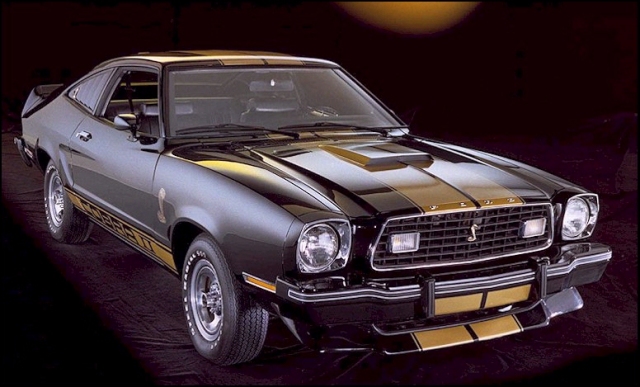
If looks were matched with speed, the 1976 Mustang would open of a can of whoop a$$ on my plain jane Impala. With the look of the Stallion Trim or the Cobra II you’d think they were carrying a no less than a V6 and hopefully a V8.

Cobra II

A spin on the original Hurtz rental Mustang.

Cobra II in Blue

Stallion Trim Package for 1976 (I’ve seen this paint job on a couple of Pintos too.)

But underneath  the Shelby type exterior or the Hurtz type color palate the cool exterior lay a 4 cylinder engine, nothing special.  But with Carrol Shelby’s endorsements and Farrah Fawcett driving one on TV the Cobra II (which was intended  to be limited to only 5,000 units) sold over 25k units.

But with the best engine you could shove under the hood, my 283 would’ve made pretty easy work of the 1976 Mustang.

Here are the engine specs that were available.

Vehicle Identification Numbers Engine Codes

140cid 2.3L 2V 4cyl 88hp Y

171cid 2.8L 2V V-6 105hp Z

302cid 5.0L 2V V-8 140hp


Thanks for reading.

Tim

Happy 4th of July 2012

Freedom starts as a dream, then a desire, then a want,  then a need, then a right, but it requires action and sacrifice to obtain.

Thanks to all those that came before us.

Car Production Numbers. They Made How Many? 1946

Fresh out of WWII the America car industry was facing the challenge of converting back to peace time auto production.  This as a huge task and the pressure was on, because if the average American owned a car there was a good change (50%) that it was 9 years old or older and needed replacing.   Materials were still in short supply, money wasn’t and to ensure that stayed the case most of the car company merely refreshed their 1942 cars.  Toss in labor issue and you can understand how tough the  situations was.

Ford lead the 17 manufacturers that year with 468,022 units produced. Chevy followed second with 398,028 cars. The others followed as such:

Plymouth – 264,660        Dodge – 163,490

Buick – 153, 627                Pontiac – 137,640

Olds – 117,623                    Nash – 94, 000

Hudson – 91,029               Mercury – 86,608

Chrysler – 83,310              DeSoto – 66,900

Packard – 30, 793             Caddy – 29,214

Studebaker – 19,275         Lincoln – 16,465

Corsley – 4, 99

1946 Crosely….not much to look at for sure but it did sport a 4 cylinder power plant.

I’m betting they meant to build this:

Thanks for reading.

Tim

Engine Line Up for 1957 Nash

Now here’s a brand you don’t see much in print.  Nash produced some very distinctive cars and as many of you know the company eventually morphed into AMC that brought us some great models like the Javelin and some interesting cars like the Gremblin.

For 1957 Nash produced the Ambassador in a couple of variations, Custom 4 door and the Super Country Club 2 door coupe (all Series 80s).

1957 Ambassador Custom

The other offering was the Rambler, which came in a couple of versions as well, the Custom 4 door (Series 20) and the Rebel (that name rings a bell…yes?  AMC Rebel?) 4 door (Series 30) and they added a station wagon as well, the Super Cross Country (Series 10 w/6 cylinder).

’57 Nash Rambler

Yup..the Super Cross Country Rambler Wagon

These were all powered by one of the following engines.

Ambassador V8 which was an overhead valve configuration with cast iron block.  327 CID with bore of 4 x 3.25 and compression of 9.0:1.  Making 255 hp with hydraulic lifters and a Carter 4bbl WCFB-2593SA carb.  Hey it had dual exhaust!!

Ramber V8 which was 250 CID, overhead valve, cast iron block power plant.  The 3.5X 3.25 bore and stroke with a 8.0:1 compression ratio help produce 190 hp.  It had no-adjustable hydraulic lifters and a Carter 2bbl model WGD-2352SA carb.

Ramber Rebel V8 which displaces 326 cubic inches rated at 255 hp and identical to the Ambassador V8 but with Solid lifters.

Lastly here was the Rambler Six.  It was an inline (straight) 6 cylinder, iron block engine with a bore and stroke of 3 1/8 x 4.25 inches.  This helped create a compression ratio of 8.25:1 and 125 hp.  It was fitted with a one barrel Carter carb, model AS-2580S.  There was an option that could be order that s was called the Power Pack which was really just a 2bbl carb that added 10 more horse power (135).  That extra boost would help when hauling around 3034 lbs wagon.

Own one of this beauties?  Drop me a comment.

Thanks for reading.

Tim

Slacking – What’s Coming Up

Yes, I’ve been slacking a bit on the blogging, but have good reason.  Ok…not really but here’s what is coming up.

–  A couple  new Engine Lineup articles

– An unexpected new project shows up

– An unexpected problem with the Mustang

– Corvette headlight issues

–  More probing on the Corvette gas gauge issues

– Corvette clutch fluid leak

– Pick up my RSS feed and your name will be entered in my monthly drawing for a die cast replica and other KOOL stuff.

Thanks for reading.

Tim

Mustang Muscle in the Mid 70′s Prt 2 1975

So we talked about the 1974 the year of big changes and small engines for the Mustang, now designated as Mustang II.  The entire idea was to return to the original roots of the Mustang, small every day car.  A far cry from the 300 plus horsepower  for the 1969-1973 Mach 1’s.  Of course it was a good idea, even though most of us don’t think so then or even now, but take a look at the numbers.The 1974 Mustang II sold over 380,000 units, and not a single V8 in the lot and that was 3 time as many Mustang as were sold in 1973.  Additionally, it was Motor Trends car of the year.  Now just between you and me,  the Motor Trend thing doesn’t do much for me (nor does the J.D. Powers award or any of the others) but it does work for some and judging by the numbers that sold at least 380,000 others.

In 1975 things changes a bit for the Mustang.  The infamous 302 returned, making a V8 an option.  But how as the possible?  What occurred that would bring back the a V8?  As mentioned above there were Mustang sold with V8 engines…”In the US“!!!!   But our friends south of the border (for those of you geographically challenged, that would be Mexico) were in fact selling Mustangs with V8.  Not many knew this was going on but once Hot Rod magazine got wind of it and put it in the front of its June ’74 issue, Ford decided that it need to “pony up” (come on now..that’s clever!!!!) and add the V8 for the 1975 edition of the Mustang II.


Your 1975 Mustang Line Up

The V8 was only available with an automatic transmission and was an option for the Ghia and the Mach I (even though the standard Mach 1 engine was the V6) as well as the other models and topped with a 2 barrel carb, it produced a whopping 122 hp or 140 hp depending on you proved the numbers.

So things were looking in 1975 although the number didn’t get even close to the 1974 model.

1975 Mustang Production Data:

69F Hatchback: 30,038

69R Hatchback – Mach 1: 21,062

60F Coupe: 85,155

60H Coupe – Ghia: 51,320

Total Production: 188,575

The total range of engine looked like this:

1975 Mustang Engines 

2.3 L – 140 cid, I-4, 2bbl, 88 hp

2.8 L – 171 cid, V6, 2bbl, 105 hp

5.0 L – 302 cid, V8, 2bbl, 140 hp

Code 

Y

Z

F

There were two transmission available a 4 speed manual and 3 speed automatic – but the 4 speed was not available for the 302.  That might seem odd but it may have to do with a fitment issue.

More coming up.

Thanks for reading.

Tim